Chapter Two: Blood and Tar
Four years at sea did that to a man — turned the deck into the only ground that made sense anymore. Off the Florida shoals, a fat Spanish merchantman wallowed low in the water, and Lou Cyphir had not yet heard the name that would change the shape of his evening.

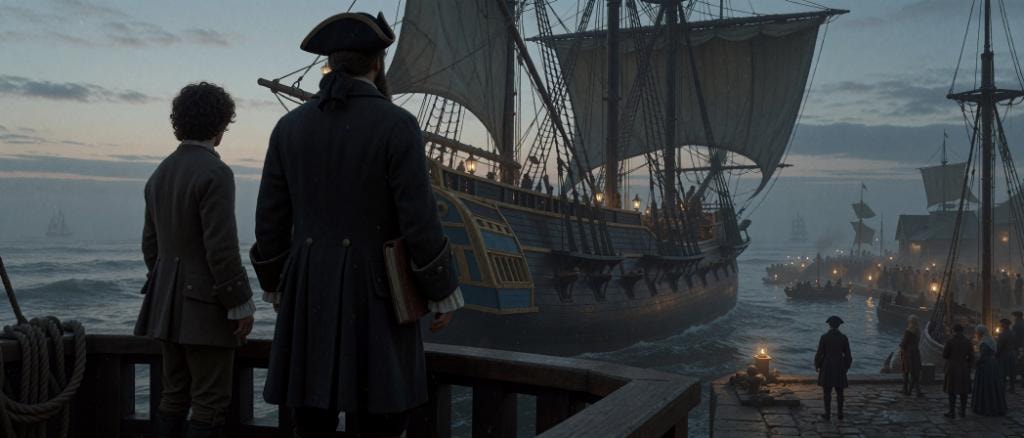
The Widow's Debt rolled beneath him like something breathing, and Lucian Cyphir had long since stopped minding the difference. Four years at sea did that to a man, turned the deck into the only ground that made sense anymore. He stood at the rail with his eyes narrowed against the glare off the water, watching a fat Spanish merchantman wallow low off the Florida shoals, and he did not think of his father's shipyard, or the mud, or the fourteen months his mother had spent dying with her eyes open. He had trained himself not to think of those things while working. Working required a clear head. The remembering came later, always later, in the black hours when the crew slept and the sea had nothing left to say to him.
He had been watching her since dawn, and a ship would tell you most of what you needed if you were patient enough to let her. She had been a smudge of canvas on the southern rim of the world at first light, and Lou had spent the whole of the morning letting her grow. The merchantman's bow wave was short and lazy, the water piling against her cutwater without any real hurry, the way it did against a hull carrying more cargo than sense. Her stern sat deep enough that the swell broke over her rudder post and ran in a white seam along her quarter. Nobody aboard her was trimming sail with any urgency. Nobody aboard her was looking back. Twice in the last hour he had watched her yaw, her helmsman hauling too hard one way and then too hard the other, and he had set both small failures aside in his head the way another man might pocket loose coins. A careful crew did not yaw. A frightened one did.
"She's riding heavy," said Nathaniel Crowe, dropping down beside him with the boneless grace of a man who had never once in his life worried about falling. Nate wore a bandana he refused to wash on the grounds that it was lucky, and a grin that had talked them both out of at least three hangings that Lou knew of, and probably a fourth he didn't. "Silver, you think? Or sugar?"
"Silver doesn't sit that low," Lou said. "Sugar doesn't sit that low either, not on a hull that size. That's something heavier. Ballast-heavy. Could be ore." He tipped his chin toward her stern so Nate could see the seam of white water for himself, though Nate's opinion on cargo weight was worth exactly nothing and they both knew it. Nate squinted at her anyway, because checking Lou's read of a ship was a habit from their first year together that neither of them had bothered to break.
"Could be nothing," Nate said. "Could be a trap. Governor's been putting bait ships out since March."
"Could be." Lou didn't argue the point, because Nate wasn't wrong to raise it. Three months back a merchantman off Nassau had turned out to carry forty soldiers below decks instead of cargo, and the Debt had lost six good men learning that lesson. Lou had written their names in the back of his logbook that night, six lines in a hand that had not quite stayed steady, and he turned to that page more often than he would have admitted to anyone, Nate included. He carried the weight of those six the way he carried everything, quietly and without letting it slow his hands. "But look where she's sailing. A navy captain wants deep water for his bait, room for the hunters to close from both sides. Nobody puts a trap on the shoals and risks grounding his own teeth."
"Maybe he's stupid."
"Maybe. But she's sluggish, and she's alone, and she's cutting a course too close to the shoals for any naval trap I've ever heard of." Lou shook his head slowly. "She's exactly what she looks like. Frightened. Carrying something her captain doesn't want to lose. Frightened men take shortcuts, Nate. He thinks the shoals are safer than we are."
"And is he right?"
"He's wrong about one of those two things." Lou straightened from the rail. "I'll tell you which when we're done."
He gave the order low, the way he always did, and the crew of the Widow's Debt began the quiet work of becoming a threat. Sails were adjusted by degrees so as not to spook a lookout scanning the horizon, a hand's width of canvas eased here, a point of helm there, until the Debt seemed to be doing nothing more than drifting down toward the merchantman on a lazy slant of wind. Men moved along the deck with their boots in their hands. Someone who had been whistling stopped mid-note and nobody remarked on it. The smell of the morning, tar and warm hemp and the sourness of bilge, thickened as the sun climbed, and below the waist the gun crews crouched beside shut ports with their match cords unlit, waiting.
Gunports stayed closed until the last possible moment. Lou had learned that much from three years under Captain Josiah Kell, who had taught him a great many things, most of them useful and a few of them true. A ship with her teeth showing was a ship that got fought instead of surrendered to, and Lou preferred his engagements to end with words rather than powder whenever the choice was his to make. Words were cheaper. Blood, once spent, didn't come back into the purse.
She understood a little past the second hour. Lou saw it before he heard it, a scramble of small dark figures in her rigging, canvas breaking out above her topsails in a hurried, uneven bloom. Then her bow swung, not away toward open sea, but inward, toward the shoals.
"She's running for the shallows," Nate said. "With that belly on her? She'll tear her own bottom out."
"Her captain knows it." Lou watched the merchantman heel into the turn, the green water creeping closer along her side. "He's betting I'm less willing to tear mine out than he is. Leadsman to the chains. Call it as you get it."
The leadsman went over the side with the line coiled on his arm, and the lead went out ahead of them with a soft plunk, and his voice came back up in the steady singsong every sailor learned before he learned to swear properly. By the mark five. By the deep four. Lou listened with half his attention and watched the water with the rest of it, the color shifting under the hull, the long pale tongues of sand running out from the shoals like fingers reaching for the deep.
He did not follow her in. That was the mistake she was inviting, and Lou had no intention of accepting it. Instead he held the Debt along the outer edge of the shoal water, upwind and seaward of her, matching her course without ever crossing the line she was so desperately hugging. You did not chase a frightened animal into a thicket. You stood at the mouth of it and let the thicket do the work.
"And a half four," the leadsman called. "Quarter less four."
"Bring her up a point," Lou said quietly to the helm, and the Debt eased away from the green, and the next call came back deeper, and nobody on deck said a word about how close that had been.
The Spaniard tried once to cut out past them. Her helmsman put her over too hard, and for a long moment she hung in the wind with her sails shivering and her whole length broadside to the Debt, as helpless as a ship could be without actually sinking. Lou let the moment stretch until he was certain every eye on her deck was turned his way.
"Open the ports," he said. "All of them. At once."
They went up together along the Debt's flank with a single hollow thump, a row of black mouths appearing where a moment before there had been only painted wood. He let her look at that for the space of a long breath. Then he nodded to the forward gun, and it spoke once, the shot going wide and deliberate across her bow to throw up a tall white column of spray that drifted back over her deck as a fine, cold rain.
It was Nate who noticed the flag change first. The Spanish merchant colors came down in a clumsy rush, replaced by nothing at all, which in its own way said more than any flag could have. A ship that struck her colors rather than raise a white one was a ship whose captain had already decided he'd rather not die today, formalities be damned. Lou allowed himself something close to satisfaction. Not joy, because he had buried the part of him that felt joy at taking things from frightened men somewhere on a hill above his father's shipyard five years back, but the flat, functional satisfaction of a plan executed cleanly.
He hailed her himself once they were close enough, in the Spanish he had gathered over four years of taking Spanish ships, which was poor but sufficient. Heave to. Hands where he could see them. No one aboard would be harmed who did not make harm necessary. The reply that came back was a single hoarse word of agreement, and then the merchantman's canvas began to spill its wind and she slowed, wallowing in the swell with her whole crew lined at the rail like men awaiting a verdict.
They came alongside with the grapnels flying and the two hulls groaning together like old men settling onto the same bench. Nate took the first line over, grinning like it was a holiday, with a dozen hands behind him and not one of them with a blade drawn, which was Lou's standing order and the one the crew grumbled at most. Lou followed, because a captain who sent other men over a rail he would not cross himself did not stay captain for long.
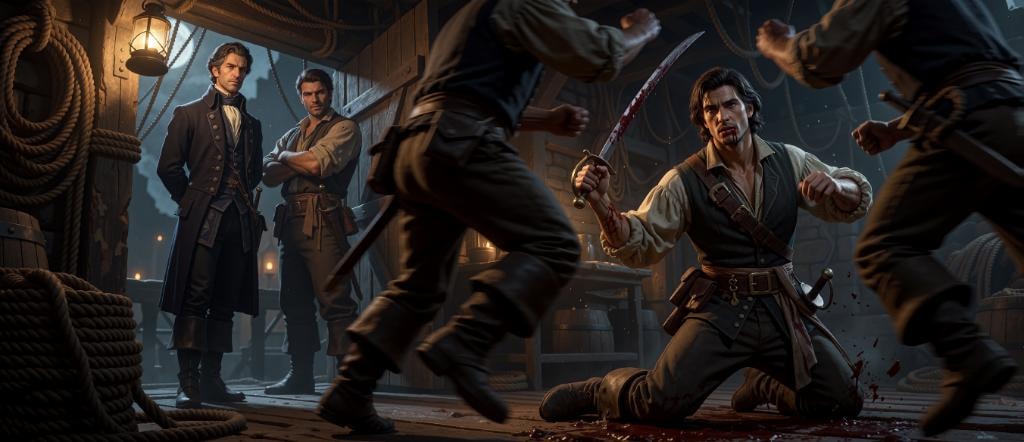
Twelve Spanish sailors went to their knees on the planking without being asked twice. Nearly all of them. A boy near the back, sixteen at the oldest, stayed standing with a pistol in both hands, leveled at Nate's chest, and the muzzle trembled so badly it seemed to be trying to point at three men at once. Behind Lou, a dozen weapons came up in answer with a sound like a single sharp breath drawn through teeth.
Lou lifted one open hand without looking back, and the sound stopped. He took two slow steps forward until he stood between Nate and the boy, close enough to see the sweat beading along the boy's lip. "Nadie muere hoy," he said. No one dies today.
The boy's eyes went to his captain. The captain barked something short and sharp, and the boy's arms sagged, and Lou reached out and took the pistol from his hands as gently as a man might take a cup from a sleeping child. He turned it over. It was a wheellock, and the wheel had never been wound. The spanner key still hung on its cord at the boy's belt. He had been holding a crew of pirates at bay with nothing but nerve and a cold piece of iron.
Lou passed it to Nate without comment.
Nate weighed it in his palm. "He'd have had to stop and ask us to wait."
"Then it's a good thing nobody made him," Lou said, and somewhere among the Spanish crew someone let out a laugh that was mostly relief, and the knot of men by the mainmast came loose all at once, the way a fist does when the man who made it finally remembers he can let go.
The boarding went easier than the fight before it usually did. Their captain came forward last, a stooped man with a gray beard and shaking hands, and he wept with relief rather than rage when Lou promised him his life and his longboat.
"No man here is touched," Lou said, to the captain and over his shoulder to his own people, in both languages so there could be no mistake about it. "No pockets, no sea chests, no keepsakes. We take the cargo and nothing else. Anyone who takes anything else answers to me."
One of the boarders, a thick-necked man who had come aboard the Debt only that spring, looked at a gold cross hanging on a sailor's neck, then looked at Lou, and thought better of it. Lou let the look pass without comment. Some lessons were better learned from a captain's silence than his shouting.
Belowdecks, packed in crates marked as ships' fittings, lay enough silver bar to make even Nate go quiet for a full ten seconds, a personal record. Lou walked the hold himself in the green gloom, with the dark smell of wet timber and old pitch pressing in on him from every side, running a hand along the crates and doing the arithmetic he always did without meaning to. Enough to keep the crew fed and armed for the season. Enough to keep the Debt seaworthy. And never, not once in four years, enough to buy back a burned shipyard or two graves on a Carolina hillside. Some debts didn't price out in silver. He had learned that lesson standing over his mother's coffin, and no amount of Spanish treasure had managed to unteach it since.
The captain's cabin told him the rest. The manifest lay open on a narrow writing desk, and it listed every crate in the hold as iron fittings bound for Seville by way of Havana. Not a single bar of silver appeared on it. Silver that sailed unregistered paid no fifth to the Crown, and silver found unregistered by the Crown's own inspectors bought a man something far worse than a lost cargo. Losing it to the Widow's Debt was a misfortune. Losing it in Seville was a rope. Lou had not been the worst thing that could happen to that man today. He had very nearly been the best.
They were gone by late afternoon, the crates hoisted across and stowed, the merchantman left wallowing behind them with her sails reset and her crew still alive to curse the day. Lou left her captain water enough for a week, biscuit, a cask of wine he didn't want, and her own compass back in its box. A man stranded with a compass and a sound hull was a man who would live to tell the story, and Lou had long ago decided what kind of story he wanted told about the Widow's Debt. She was the ship that left them breathing.
It was the merchant captain who said the name that changed the shape of Lou's evening. He was babbling gratitude and terror in equal measure as they lowered him into his longboat, one hand clutching the gunwale as though it might be taken from him yet, and what he said, in a rush, as if the words were coins he could press into Lou's palm, was this. "You are merciful, señor. More merciful than the men who took the Aránzazu last spring. Cortez does not leave men alive to be grateful."
He said it the way frightened men say things they think will earn them favor, a compliment disguised as comparison, and he had no way of knowing that the name had landed on Lou like a struck flint. Rafael Cortez. One of three men Lou had hunted since he was nineteen years old, and the only one of the three he had a name for, pulled out of the ash by a year of patient asking in taverns and shipping offices and the back rooms of men who talked for coin. He had carried it in his chest ever since, written there in a hand steadier than his voice had been the night he first heard it spoken plainly.
He did not ask the captain where. He did not ask when, or which way the killers had sailed, or whether the man had seen Cortez's face. Four years of this life had taught him that a question was a door, and a captain who had just been shown mercy would walk through any door a merciful man held open, then carry word of who had opened it to every port from here to Havana. The men worth fearing were the ones who gave nothing away. Lou did not let his face change at all.
The captain gave him the rest anyway, because frightened men always did. "A fisherman found her drifting off the Caicos with her sails half set," he said, crossing himself. "Her decks were scrubbed, señor. Not a drop of blood, and not one man aboard. That is how you know it was Cortez. Other men leave you bodies to bury. Cortez leaves you nothing at all." His voice dropped. "The English in Nassau tell the story best. They drink to it, I think, so they will not be next."
Lou nodded once, slowly, as though the information were of only passing interest to him, and made a small gesture to the men at the falls. The longboat dropped the last few feet to the water with a slap, and the Spaniards bent to their oars without looking back.
But when the longboat pulled clear and Nate turned to him grinning, already halfway into a joke about their haul, he found Lou staring out toward the empty southern horizon with a flat, functional stillness Nate hadn't seen in a long while, not since a night in a Carolina tavern when Lou had first told him, quiet and flat and final, that there were three men, that he had one name, and that he intended to find the other two and kill all three before God or the gallows caught up with him first.
"Lou," Nate said, the grin fading. "What is it."
Lou didn't answer right away. He was thinking of a burned shipyard, and a woman by a window, and the pale shade of gray the Carolina sky had turned the morning they'd buried her. Then he turned to Nate, and his voice, when it came, was the coldest thing on that ship.
"Change of course," he said. "We're going hunting."
Continue the pirate serial
ReadChapter Three: The Trouble With NassauHow did this chapter find ye?
Written by
Lou Cyphir
Pirate. Storyteller. The Devil's own entertainer. Lou Cyphir sails the Carolina coast and writes dispatches from the black waters — one chapter at a time.