Chapter Three: The Trouble With Nassau
Nassau in 1596 was not a port so much as an argument that had been going on so long everyone had forgotten how it started. Lou Cyphir had learned better than to run a crew's patience too far into the red. The trouble, as always, found him first.

The Widow's Debt put into Nassau three days later, low on fresh water and lower still on the kind of patience a crew needed before a hunt, and Lou had learned better than to let either run too far into the red.
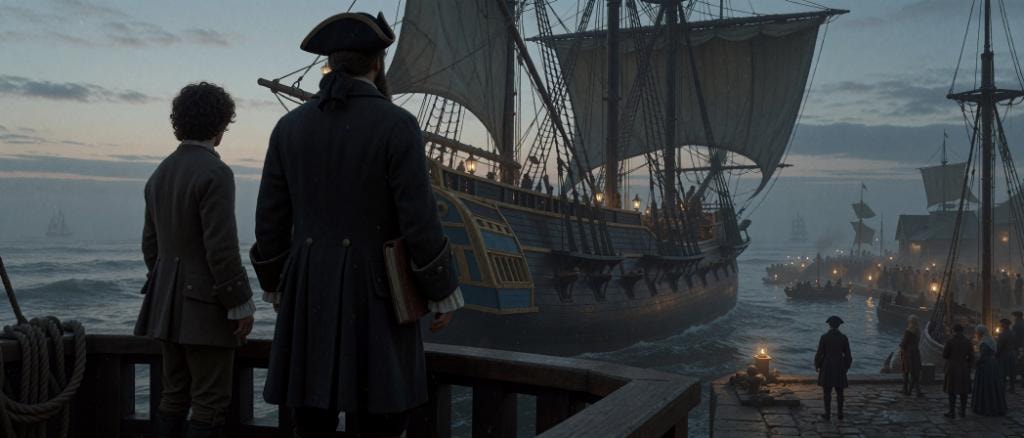
Nassau was not a port so much as an argument that had been going on so long everyone had forgotten how it started. Pirates, wreckers, half-ruined Spanish claims, and English settlers who called the whole arrangement a colony because the alternative was admitting nobody was in charge of anything. The harbor stank of fish guts and tar and cooking smoke, and the long white curve of the beach was littered with careened hulls lying on their sides like beasts too tired to stand.
It suited men like Lou. Nobody in Nassau asked too many questions of a ship riding low with silver in her hold, so long as that ship spent freely enough in the taverns to make the asking not worth anyone's trouble.
Nate was ashore within the hour, which surprised no one, and back within two, which surprised Lou considerably. Nate returning early from a port town was a phenomenon on the order of an eclipse, rare enough that Lou looked up from the quartermaster's ledger to ask what was wrong.
Nothing was wrong. That was, Lou would come to understand, precisely the problem.
Nate had the look of a man who had walked into a dockside shop for rope and walked out with an entirely different set of priorities. It took him three attempts to explain that the priorities in question were named Isabela Reyes, that she ran her father's chandlery near the harbor, and that she had informed him, in the course of a single transaction involving line and pitch, that his flattery was wasted on a woman who could out-haggle a Genoese banker. She did not, she had added, care for men who thought a smile could do the work of an honest price.
Nate relayed this with the reverence of a man describing scripture.
"You're in love," Lou said. It wasn't quite a question.
"I'm in commerce," Nate said. "There's a difference. A significant difference. I need forty fathoms of good line, and she has the only chandlery in this port that isn't selling rope that rots in a fortnight. If in the course of that entirely legitimate business I happen to think she's the finest thing I've seen since we left the Carolina coast, that is a separate matter and none of your concern, Captain."
Lou let it go. Arguing with Nate in this mood was like arguing with weather, and the crew needed water and provisions regardless of whose heart Nate had misplaced in the arranging of them.
He went ashore himself the next morning to oversee the loading. He would not have admitted the other reason even to Nate. Four years of hunting men who didn't want to be found had left him with very little appetite for sitting still on a ship while his quartermaster conducted a courtship.
Lou had no business envying a man with room in his chest for anything but the hunt.
Nassau's waterfront market was its usual chaos. Shouted prices, stolen goods sold as honest salvage, a man selling live turtles from a tipped-over barrel, and the heat coming up off the packed sand in waves. Lou was three stalls deep into it, haggling over salt pork with a merchant who had never met a customer he couldn't overcharge, when the trouble found him instead of the other way around, which was how trouble generally preferred to operate.
It came in the shape of four men.
They had the look of privateers who had lost a prize they'd already spent in their heads, and were hunting for whoever was nearest and least expecting it. Their leader was a barrel-built man with a nose that had been broken more times than it had been set and a sunburn that had given up peeling years ago. He had recognized Lou with a slow and unwelcome dawning, as the captain who had relieved a certain Spanish merchantman of her silver three days before.
Word traveled fast on the water when silver was involved.
The big man put a hand on Lou's shoulder with the weight of someone who meant it as anything but friendly. Lou smelled rum on him, and old sweat, and under both of them the sour edge of a man who had been wrong about something for a long time and had not yet found anyone to blame.
"Cyphir," the big man said, quiet and almost pleasant. "We've been circling that merchantman three weeks. Seems to us the Widow's Debt owes the honest privateering trade a debt of its own, taking a prize other men were working."
Lou did not raise his voice. That was always the moment to worry about Lou, as Nate liked to say, rather than for him.
"You circled her for three weeks and never once closed," he said. "I took her in an afternoon. That isn't theft. That's arithmetic."
The big man did not appreciate the correction.
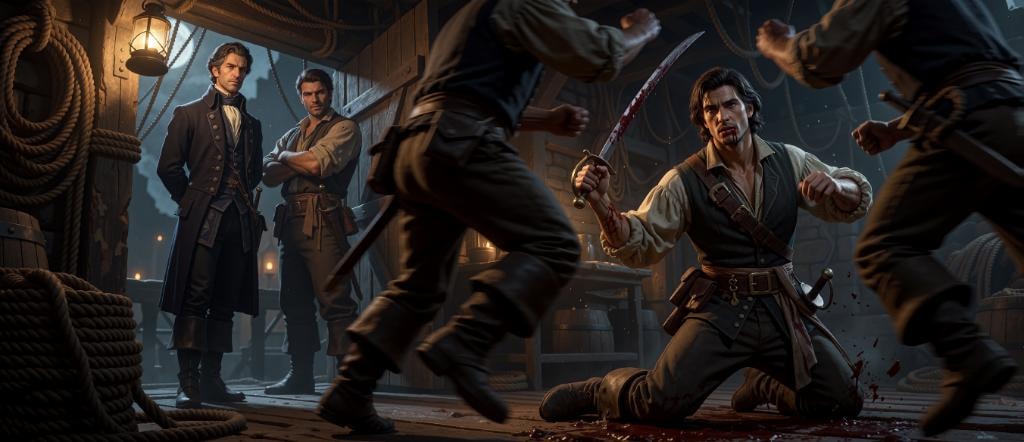
The market went from haggling to brawling with the speed of a port where half the population had been waiting all week for an excuse. A fist came at Lou's jaw and he turned his head into it so it only glanced, then put the first man down with an elbow to the throat. The second took the flat of a belaying pin Lou had lifted off a nearby stall for exactly that purpose. Somewhere behind him a table went over, and the turtle seller began shouting about his turtles.
It was, by Lou's own later accounting, going reasonably well.
Then the big man got an arm around him from behind, and the sunlit square tilted. Lou drove his heel down the other man's shin and felt the grip loosen. He twisted free, took a knuckle across the mouth that split his lip, and tasted copper. For a moment the whole street had narrowed to breath and boots and the roaring in his ears.
And in the middle of it the door of a shop banged open on the far side of the square.
"Not one more boot," said a woman's voice, sharp and furious and entirely unbothered by the violence going on twenty feet from her shopfront. "The next man who puts a foot through my father's barrels over a dockside grudge will pay for them out of his own hide. Captain or privateer or the king of Spain himself."
The brawl did not so much end as stumble to a halt. Every man in the square turned to look.
She stood in the doorway of a narrow shop with ropes hanging in coils from its front beams, a boat-hook in one hand and an expression that said she had broken up more waterfront fights than the local watch had. She was perhaps twenty-five, dark-haired, with rope-callused hands and a streak of tar across one cheek, and she looked at four bleeding men and a captain with a split lip as if she were pricing them.
The sheer novelty of the interruption did what neither Lou's fists nor the big man's threats had managed. It stopped things cold.
Nate arrived at a dead run from the harbor, shirt half untucked, a half-eaten fig still in his hand. He took in the whole scene at a glance. Isabela commanding the street. Lou bleeding faintly from his lip. Four privateers nursing bruises and reconsidering their lives.
His face lit with the particular delight of a man whose priorities had just been thoroughly vindicated.
"See, Captain," he said. "Commerce."
Isabela turned the boat-hook on him without lowering it. "You're the one who wanted forty fathoms."
"That's me."
"Then you're the reason this is my street's problem." But the corner of her mouth moved, just slightly, before she controlled it. She looked at Lou next, at the split lip and the pin still in his hand. "And you're the captain he won't stop talking about."
"I'd have assumed he'd talk about you."
"He did. For an hour. It was exhausting."
Lou felt, absurdly, something near a smile pull at the stiff side of his mouth, and put it away again. The big privateer was watching the exchange with narrowed eyes. His gaze went from Isabela, to the sign above her door, and back again. Lou saw him fix the shop in his memory the way a man fixes a mark on a chart.
He didn't like that. He filed it with the other things he didn't like and did nothing about it, because there was nothing to be done about it yet.
They left Nassau at dawn the following day, with the water casks full and forty fathoms of good line coiled belowdecks. Nate swore the discount had nothing to do with his conversation with Isabela and everything to do with volume purchasing. There was also a promise, extracted more by Nate's insistence than any inclination of Lou's, that the Debt would put back into Nassau before the season turned.
Lou stood at the rail as the harbor fell away behind them, dabbing at his lip with a rag and watching the gap of green water widen. He did not mention the other thing he had carried out of that market.
It had come at the end of the fight, when the big privateer was on one knee spitting blood and cursing in rough Spanish. In the middle of the cursing he had sworn by his captain's name, the way a man does when he is sure the name will protect him. Lou had heard it once before, in a back room in Tortuga, spoken low and in the same breath as Cortez's, by a man too drunk or too frightened to say more. At the time it had meant nothing. A name attached to another name.
It meant something now.
It was not proof. It was a thread, and Lou had learned how little a thread was worth until you pulled it and felt what was tied to the other end. But it was the second thread he had held in four years, and it had come to him in a market square, from a man who had no idea what he'd said.
The hunt, it seemed, had found them before they had even properly begun it.
Continue the pirate serial
ReadChapter Four: The Weight of NothingHow did this chapter find ye?
Written by
Lou Cyphir
Pirate. Storyteller. The Devil's own entertainer. Lou Cyphir sails the Carolina coast and writes dispatches from the black waters — one chapter at a time.