Chapter Twenty-One: What the Ledger Held Back
The ledger gives up its last secret, and Lou learns the name behind the name.
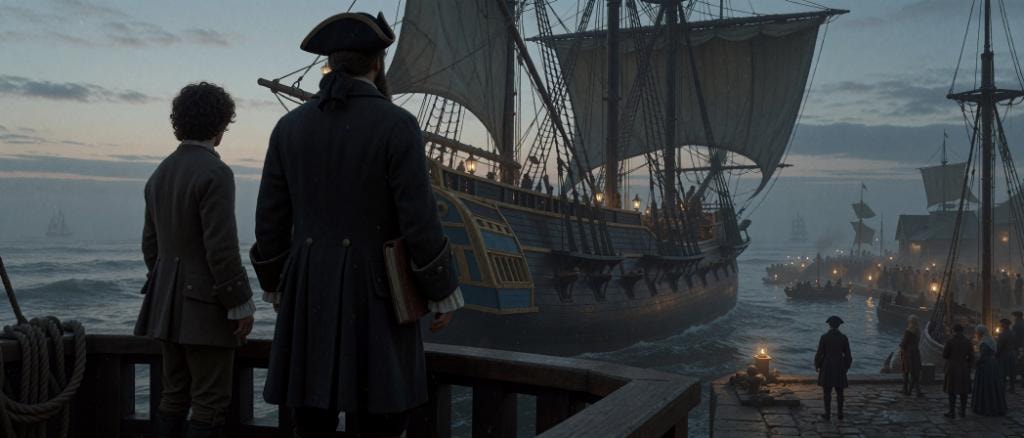
Nate found him on the quay at first light, and whether that was luck or the plain fact that he'd been walking every street between the ship and the ropewalk since the middle of the night, he never said, and Lou never asked.
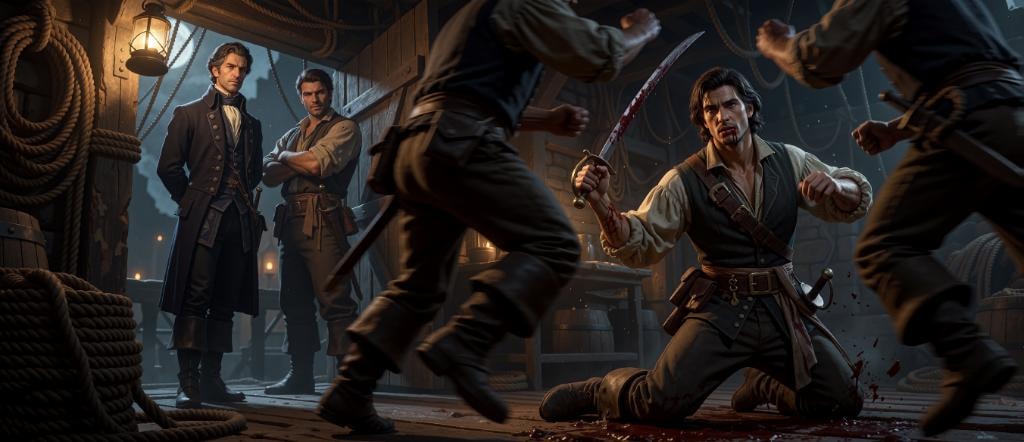
Lou was sitting with his back against a piling and his coat held shut in one fist, one eye swollen nearly closed and his lip split down the center, and when he heard boots coming at a run along the planking he looked up with the expression of a man who'd been dreading exactly this moment for the better part of an hour and was too worn through to dress it up as anything else.
"Don't," Lou said.
"I've not said a word."
"You were about to."
"I was about to say a good many, and I'm choosing the shortest of them." Nate went down on one knee in front of him, hands already moving over Lou's ribs with a quartermaster's brisk lack of ceremony, and the color that had drained out of his face did not come back as he found what there was to find. "You went alone."
"I did."
"After that man told you plain about the doors, and who'd be answering them."
"I remember what he told me." Lou let his head rest back against the piling and closed his good eye a moment. "Help me up. You can give me the lecture on the way."
Nate never gave the lecture. That was the part Lou would turn over afterward, in the long quiet hours of the watches that followed, more than the beating itself or the face in the doorway. Nate only got a shoulder under Lou's arm and walked him the whole length of the merchant quay at the pace of a man who would have carried him every step if asked, and he said nothing at all until the Widow's Debt came into sight, her lamps still burning at the gangway in the gray morning because nobody aboard had been willing to be the one who put them out.
Vincent was waiting at the rail. He hadn't slept either, and didn't trouble to pretend otherwise. He looked at Lou's face, and then at the fist still holding the coat shut, and something quick and private passed over his own face before he settled it back into the careful stillness Lou had long since learned to read for what it hid.
"They knew you'd come," Vincent said.
"They knew I'd come sooner or later. All they had to do was stand where I was going and wait for me to arrive." Lou lowered himself onto a coil of line on the deck, and it took him a good deal longer than it should have. "Whoever wrote that name down for Margot may well have known she'd sell it to me. It felt, walking into that place, like stepping onto a stage somebody else had built and lit, with my part already written for me."
"The man with the lantern," Nate said.
"A face I'll know again, wherever I see it. And another beside him, younger, broad through the shoulder as a door. I couldn't tell you which of the two gave the order, and I couldn't tell you which of them is Cortez." Lou pressed two fingers to the swollen eye and winced. "If either of them is."
For a while none of them spoke. The harbor was waking up around them, carts on the cobbles and men shouting cargo and the clank of the first lighters putting off from the men-of-war, and beneath all of it, Vincent said quietly the thing he'd been carrying since the cordage stall the day before.
"I'd like to say this before you decide anything. The man in the market asked after me. Not after the ship, not after you, after me, by description, the way a man asks when someone's paid him to ask." He kept both hands flat on the rail, which Lou had learned meant they'd otherwise have been doing something he didn't want seen. "I don't believe they came to take the ring off me. I believe they came to see whether I still carried it. And I believe the man with the lantern and the Undertow may sit a good deal nearer to the same hand than any of us has wanted to guess."
"Then it isn't two hunts at all," Nate said slowly. "It's one."
"Or two that share a door." Lou looked at the pair of them, the boy who'd come out of the sea clinging to a raft of lashed barrels and the man who'd never once in all their years together let him sail into trouble alone, and felt something rise in him that wasn't quite gratitude, because gratitude was too small a word to hold it. "Hear me, both of you. I'm finished going off on my own, and I'm finished letting either of you do it. Whatever comes for us next, it comes for the three of us together, at the same table, with the same knowledge. Agreed?"
"Agreed," Nate said at once, as if he'd been waiting years to be asked.
Vincent took longer about it, and when his answer came, it was the honest one, which was the only kind he'd learned to trust. "Agreed. So long as the captain keeps his half of it as faithfully as he means us to keep ours."
"I'll keep it," Lou said. "You have my word on it, for whatever my word's worth to you this morning."
"It's worth more than you'd think," Vincent said, and looked away, out toward the harbor mouth, before Lou could see his face too clearly.
Five days earlier, while the Widow's Debt was still somewhere out on the open water between, and Lou had not yet so much as sighted Port Royal, Brigid was back in Marrow's Reach carrying a crate of lamp oil down the same jetty she'd walked every day since that ship first sailed in, and trying very hard, and very unsuccessfully, not to look at the horizon.
"You're doing it again," Isabela said, falling into step beside her with a sack of nails propped on her hip.
"I'm doing no such thing."
"You've looked at the harbor mouth six times since we left the chandlery. I counted, and I wasn't even trying to."
"Then you've more idle time on your hands than I'd have guessed." Brigid set the crate down harder than the oil deserved. "It's a harbor. People look at it. That's what it's for."
"People who haven't handed a captain a new logbook and called it plain practicality."
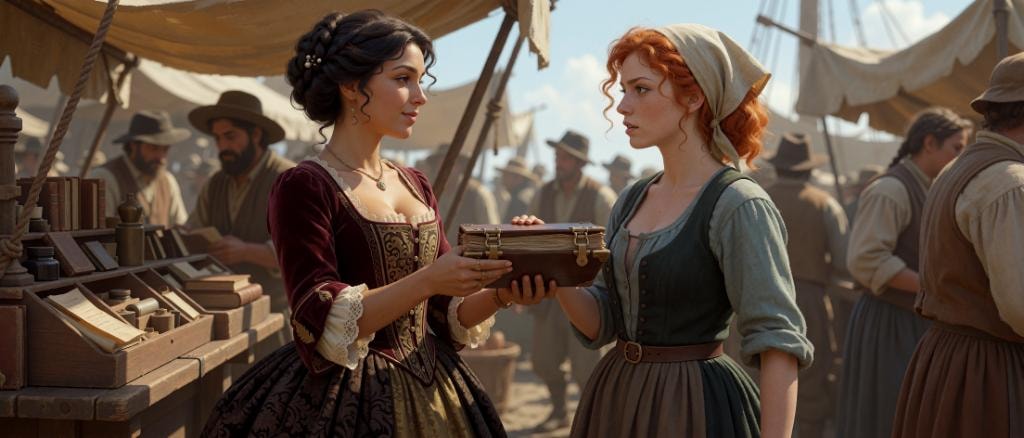
"It was practicality. His old one was coming apart in his hands."
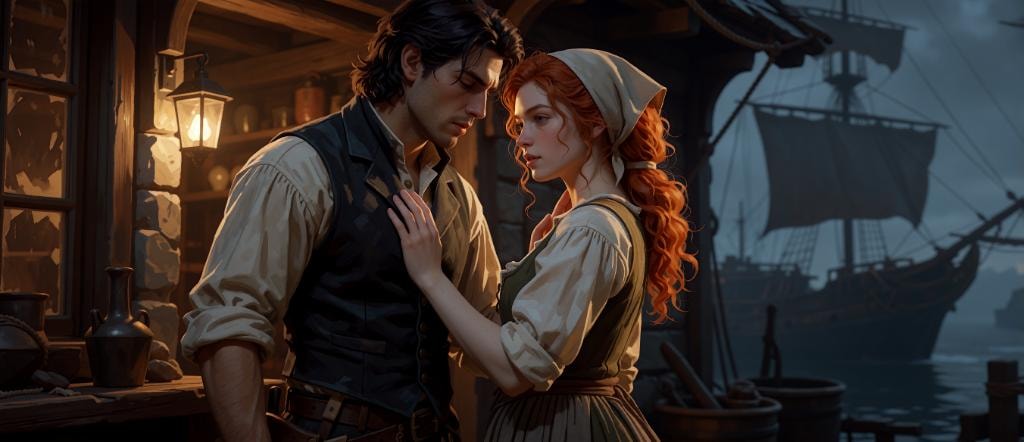
"It was a very fine book, in a very fine cover, and you set your hand on his chest after like you were testing whether a beam would bear weight." Isabela's mouth twitched at the corner. "I've known you eleven years, Brigid. I've watched you give men a good deal less than that for a good deal more cause."
Brigid opened her mouth to answer and closed it again, because from the stone steps beside the harbormaster's office a voice called down, "Ladies. I'd hoped I might find the two of you together," and there was no mistaking whose voice it was.
Margot came down the last of the steps with her skirts held clear of the wet stone and her hair, for the first time in Brigid's memory of her, not quite perfectly pinned. She wore no gloves. A smear of ink ran along the side of her right hand, and she didn't seem to have noticed it was there, which was, of everything about her that morning, the thing that unsettled Brigid most.
Brigid straightened where she stood. Isabela, without appearing to move at all, shifted half a step so that she stood a little in front of her.
"I've not come to quarrel," Margot said, reading the both of them in an instant the way she read every room she walked into. "I did my quarreling over a logbook in the market, and lost it fairly, and I'd like to think I lost it with some grace. I've come because I've been sitting up three nights now with my own ledger open in front of me, and I find I can't sleep until I've told what's in it to somebody who'll carry it honestly."
"We're not your couriers," Brigid said.
"No. You're better than couriers. You're the two people in this port that captain would believe without stopping to check." Margot glanced up the jetty and down it, and lowered her voice. "Walk with me a little way. Please. It won't take long, and I'll carry your oil."
Brigid looked to Isabela. Isabela lifted one shoulder, which meant she was curious and would deny it to her grave, and so the three of them walked the length of the jetty together, with a woman who made her living off other people's secrets carrying a crate of lamp oil in her ink-stained hands as carefully as if it held glass.
"Two things," Margot said, once they'd reached the last bollard, where the planks ended and there was nothing ahead but water. "The first I'd like you to hear before the other, because it's the one that will frighten you. The old man out past the point. Kestrel."
Isabela's head came around sharp. "Vincent's Kestrel."
"His door's been standing open since the night before last. Table overturned. Cot stripped bare. No blood that I could find, and I looked hard, which I'll thank you both not to repeat to anyone." Margot's voice held steady, but her ink-stained hand tightened on the crate until the knuckles showed. "The fishermen say a boat lay off the point after dark with no lights showing, and was gone again before the tide turned. Nobody saw faces. Nobody ever does, with that kind of boat. But Kestrel was a man who made a whole trade out of knowing exactly who stood in his house and why, and he did not leave that house of his own accord."
Brigid said, slowly, "He told Vincent they were circling him."
"Then he was right, and they've finished their circling." Margot let that sit between them a moment. "I'm sending word to the ship by a fast sloop that sails on tonight's tide. With a kind wind behind her, she should reach Port Royal in time to find the Debt still in harbor. But I wanted the two of you to know what I'm sending, and why I'm sending it. That boy will take this news in silence. Boys raised the way he was always do. When you see him again, don't let him keep it there. Silence is where that kind of hurt goes to grow."
"And the second thing," Isabela said, in the flat voice she used when she very badly wanted to be angry at someone and couldn't find the right target for it.
Margot was quiet a long moment, looking out at the water rather than at either of them, and when she spoke again there wasn't a trace of performance anywhere in it.
"When your captain asked me for the financier's name, I gave it to him. I gave him everything I'd confirmed, every word of it true, and I kept one line back." She turned the oil crate a quarter turn in her hands. "I'll tell you why, so you don't think worse of me than I've earned. A woman in my trade sells everything she has, in the end. But I always keep one line back. One line I won't write down until I've seen what the buyer does with the first. It's the only way I've found to learn whether a man is worth the rest of it. Your captain went into Port Royal with his eyes open and his father's letter in his coat, and in all our dealings he never once asked me for a favor I hadn't named first myself. That's rare enough in my experience that I've decided to pay for it."
Brigid's voice came out rougher than she meant it to. "You've put him in the way of it. You gave him a name and a port and sent him straight into danger."
"I gave him a name and a port because that was the honest half of what I had. I can't know who's waiting for him in a city I don't govern, any more than you could." Margot met her eyes and held them steady. "But if there's more waiting for him in Port Royal than a name, I'd rather he had the second half of it in my own hand before he finds out the hard way. It goes on the sloop tonight. I wanted you both to know that it exists, and that it's real."
"What does it say?" Isabela asked.
"That I'm sorry for the line I held back, to begin with. And where the man he's hunting is bound to be, once the weather lets him go there." Margot set the crate down at their feet, gently. "There's only so much even I can sell. I find I'd like, just once, to give something away for nothing."
None of them said anything. A gull came down onto the bollard beside them, considered the three women a moment with one cold yellow eye, and thought better of it.
Brigid found, to her own considerable irritation, that she'd put out her hand. Margot looked down at it a moment, and then took it, and the handshake was brief and exact and nothing at all like the one in the market square.
"Thank you," Brigid said, and it visibly cost her something to say it. "For the book. For letting it go."
"You'd have thrown it at my head if I hadn't." Margot's smile came back then, small and a little rueful at the edges. "He's a very lucky man, shopkeeper. I do hope he knows it."
She went back up the jetty without waiting for any answer, one hand lifted in a farewell that didn't quite become a wave, and Brigid stood watching her go with the lamp oil at her feet and her face doing something she hadn't given it permission to do.
"Well," Isabela said at last, after a long moment. "I think that may be the kindest thing anyone's ever said about you in my hearing."
Brigid didn't answer that. She only wiped her eyes with the back of one wrist, quick and fierce, as if the salt wind had put something in them, and bent and picked up the crate, and carried it the rest of the way down the jetty without once looking back at the harbor mouth, which Isabela, being a true friend, did not count.
The word from Margot found the Widow's Debt at dusk on their second day in Port Royal. Her sloop had brought it in, but it was the man with the signet ring who carried it the last of the way, climbing the gangplank with his coat buttoned to the chin and a sealed letter held out before him as carefully as if it might go off in his hand.
"This came in on a sloop out of Marrow's Reach this evening," he said. "It was addressed to me, and inside it was addressed to you. I don't read other men's letters, Captain, whatever else I may do for my living." His eyes went to the split lip, the swollen eye, the careful, deliberate way Lou held himself upright. "I see you found my warning more useful than I'd intended it to be."
"Not useful enough," Lou said.
"No. A warning seldom is, in my experience. It's a poor sort of shield that only works when a man is already listening." He bowed, one short economical motion, and went back down the gangplank without another word.
They read it in the cabin with the door shut, the three of them gathered around the table where the charts lay, as they had agreed on the deck that morning. Lou broke the seal himself. The hand was Margot's, hurried and slanting across the page, a page and a half of it, and he read it through once in silence first, and then again aloud, because that had been the agreement, and because Vincent had long since stopped pretending he wasn't listening.
The first half concerned Kestrel. Lou read it out plainly, without softening a word of it, and watched the boy hear it. Vincent didn't move. His hand came off the table and went to his pocket, where the iron ring was, and stayed there. When Lou reached the end of the paragraph and looked up, Vincent's eyes were fixed on some point beyond the cabin wall, and what showed in them was neither grief nor fear. It was something a good deal older than either, patient and cold, the look of a thing that had learned long ago to wait.
"They took him because of me," Vincent said.
"They took him for what he owed them," Nate said. "That debt was his long before it was ever yours."
"Same thing, in the end." Vincent finally looked at them. "He told me to stay clear of them. He told me plain what they were. And he stood in that doorway and let me walk away from him rather than ask me for a single thing." His jaw worked once, the way it did when he was holding something down by main force. "I didn't forgive him. I told him so to his face. I'd like very much to be given the chance to tell him again, and maybe this time mean something different by it."
"Then we'll see that you get that chance," Lou said. "That's the next thing we do, after this."
"After this."
"After I've finished the page." Lou lowered his eyes to it again.
The second half was shorter, and Margot had written it more carefully than the first, as if each line had been weighed out on a scale before her pen ever touched the paper.
I kept this back, Captain, and I am ashamed of it, so I will say it plainly. The financier's money did not move through Port Royal alone. Rafael Cortez drew his commission against a bond, and the bond carries a clause his financier insisted on. He must bring his prizes, or what is left of them, to be condemned and divided at one named place, within a named season, or the paper falls void and every coin of it comes due.
The place is no harbor on any chart you or I have sailed by. When the great fleet went down in the summer blow off the Florida coast, the Spanish put salvage camps on the beaches to pull the silver back out of the surf. The financier has bought himself a share of whatever is taken there, and Cortez's bond names that coast. The camp the Spanish call the Palmar. His ship will lie off it before the turn of the year, because the clause leaves him no other choice.
You will find the camp by its smoke, by the Spanish colors, and by the wrecks on the reef. You will find him, I think, by waiting. He cannot afford to be anywhere else.
I hope this finds you whole. I hope you will not need it. Whatever else you may owe me, I consider the account between us closed.
Below it, in a different ink, as if added in the last moment before the seal went on, there was a single line more.
Tell the shopkeeper her oil was heavy, and that I said so with respect.
Lou read that last line twice over, and the corner of his mouth, the one that wasn't split, moved in spite of everything. Then he laid the page down on the chart table, over the long stretch of coastline he'd stared at for four years without ever once finding what he was looking for, and set one finger on the pale curve of shore south of the Cape, where the reef ran out into open water.
"The Palmar," Nate said, leaning over to look. "The better part of a fortnight's sail from here, weather permitting. Longer if we put in anywhere along the way."
"We won't put in anywhere."
"You're in no shape for a fortnight of anything."
"The ship's in better shape than I am, and she's the one doing the sailing." Lou's finger didn't move from the chart. "Vincent. You'd have us go for Kestrel first. I'd not blame you for it."
"I'd like to." Vincent's voice was steady, and they could both see what that steadiness was costing him. "But I know now where Cortez is bound, and I don't know where Kestrel is. A man you can find is worth more than a man you can't, and the sea's taught me that lesson harder than it's taught most." He drew a breath. "We take Cortez at the Palmar. And while we wait on him, I'll ask along that coast about boats that lie off at night with no lights showing. The Undertow does its business wherever silver is. It always has."
Nate straightened up from the table, and for the first time since Marrow's Reach he looked something like himself again. "Four years," he said. "Four years, and he's never once been where we were looking for him. And now he's bound by his own paper to walk into this one on a schedule. A man doesn't get to come late to his own condemnation."
"No," Lou said. "He doesn't."
Outside, the harbor lamps were being lit along the quay one after another, and somewhere beyond the anchorage the long swell of open water was already rising and falling under the coming dark. Lou thought of a burned shipyard and a hillside in Carolina and a woman by a window. He thought of the sealed packet he'd carried here, and the name he'd read once and lost before he'd had the use of it, and a man in a warehouse doorway watching him go down with the unhurried patience of someone who had never once in his life been in a hurry.
Then he picked up Brigid's logbook, opened it to a clean page, and wrote a heading across the top in a hand that didn't shake at all.
The Palmar. Before the turn of the year.
They cleared Port Royal before dawn on the ebb tide, with the lamps doused and the canvas set quiet, the way a ship leaves a harbor when she'd sooner not be remarked on. Nate had the helm. Lou braced himself at the stern rail with the logbook tucked beneath his coat and watched the harbor shrink away behind them to a scatter of lights, and then to a single light, and then to none at all.
Vincent came to stand beside him. He hadn't slept, and didn't pretend he had.
"There was a man on the quay," he said, "when we cast off. A man in a dark coat, standing very still, the way the one at Governor's Harbor stood. He never watched the ship leave. He watched me."
Lou didn't turn his head. "Did he follow?"
"He didn't need to." Vincent's hand went to his pocket, to the familiar weight of the iron there. "He only needed to see which way we were headed."
For a long moment neither of them said anything more. Ahead of the bow the sky was beginning to go gray at the edges, and somewhere beyond it, a long way off and a little more than two weeks' sailing, a beach was waiting for them, with smoke rising off it and Spanish colors flying over it and a man who could not afford to be anywhere else.
"Then let him watch," Lou said. "We'll be there first."
How did this chapter find ye?
Explore Topics
Written by
Lou Cyphir
Pirate. Storyteller. The Devil's own entertainer. Lou Cyphir sails the Carolina coast and writes dispatches from the black waters — one chapter at a time.