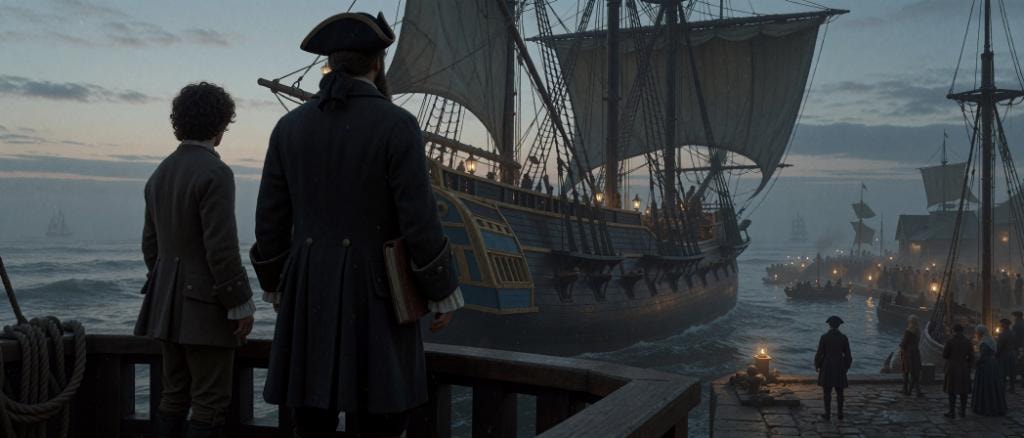
Chapter Four: The Weight of Nothing
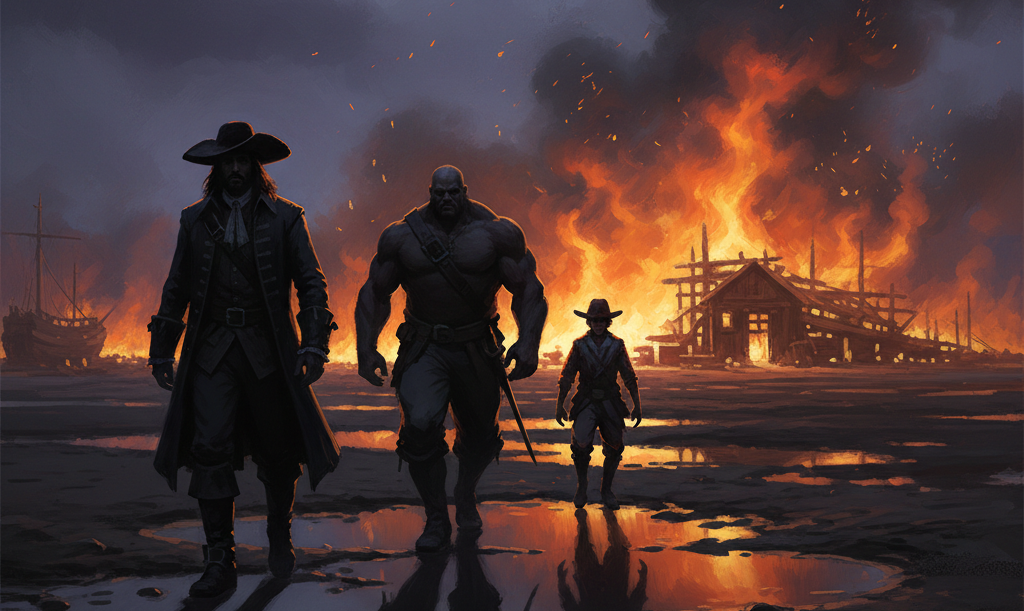
Three men who felt nothing at all had just decided the shipyard's fate. Cortez did not look back at the fire he was leaving behind him — the way he never looked back at anything.
The screaming had stopped somewhere behind them, swallowed by the alley's turn, and Cortez did not look back to check whose it had been.
Three shapes cut through the wet dark of the harbor district, Cortez in front, long-legged and unhurried even at a run, with Dutch Aariq a step behind him cradling a canvas sack against his ribs like a nursing child, and behind them both, Sorrel, the smallest of the three and by far the meanest, wiping the flat of his knife clean against his own trouser leg as he moved.
They had come from the counting house on Merchant's Row with more silver than any of them had held in a single hand in a year, and they had left behind them two guards who would not be standing come morning, and a clerk who had been foolish enough to reach for the bell rope. None of the three men thought of the clerk again after the door shut behind them. Grief was a currency for men who could afford it, and Cortez had long since spent whatever store of it he'd ever owned.
They didn't run far. Three men sprinting through the Cradle District at this hour drew eyes, and eyes were worse than watchmen. So a hundred yards on, Cortez slowed to a walk, then to a saunter, straightened his coat, and the three of them became nothing more than dockhands heading home late, indistinguishable from the tar and salt of every other soul stumbling out of a tavern door.
It was in one of those taverns, The Hanged Gull, low-ceilinged and thick with pipe smoke, that they first heard the name of the shipyard.
They'd gone in for the noise as much as the drink; noise was cover, and cover was a habit older than any of them could remember choosing. Sorrel found them a table near the back wall, out of the light, and Dutch went to fetch three tankards, and Cortez simply sat, and listened, the way he always did, not to the room, but past it, the way a man listens for the second step behind him rather than the first.
That was how he caught it.
Two tables over, a dockworker, broad through the shoulders, red in the face from drink, the kind of man who has never once in his life been trusted with a secret and does not know it, was telling anyone who'd have him about the new ships going up at a yard south along the coast. Six hulls, near finished, commissioned by the Crown's own agents and worth more towed away whole than anything a man could carry off in a sack. No proper garrison anywhere near the place, he said, leaning in like he was the first man ever to whisper a thing in a tavern, just a shipwright, his family, and a scattering of hands who went home to their own beds come nightfall. Ripe, he called it. Sitting there in the dark, ripe as fruit gone soft on the branch.
"Ripe," the dockworker said again, delighted with himself, "and nobody watchin' it worth a damn."
Cortez didn't turn his head. He didn't smile, either, smiling was for men who needed the room to like them. He simply set his tankard down without a sound and looked at Dutch, and then at Sorrel, and something passed between the three of them that needed no words at all, because they had done this dance enough times to no longer require the music.
Sorrel's hand had gone still on the table, his knife-cleaning forgotten. Dutch's jaw worked once, twice, the closest thing to excitement the big man ever showed. And Cortez, Cortez only leaned back in his chair, unhurried, and let the dockworker keep talking, because a man mid-boast will tell you everything if you simply let him enjoy himself long enough.
They did not lurch up from the table. They did not so much as raise their voices. Haste was for men who hadn't planned far enough ahead to be patient, and patience was the only inheritance Cortez had ever bothered to collect. He let a full hour pass. He bought the dockworker a drink himself, clapped him once on the shoulder like an old friend, thanked him kindly for the company, and the fool never once understood what he'd handed away, or to whom.
It was only once they were three streets clear of the Gull, walking easy under a sky gone the color of a fresh bruise, that Cortez finally spoke.
"No garrison at all," he said, "for six hulls that size, is an insult." He said it the way another man might comment on the weather, mild, almost bored. "Someone ought to teach them better arithmetic."
Dutch laughed, low and short, more breath than sound. Sorrel didn't laugh at all. Sorrel only smiled, and it was not an expression that belonged on a human face by rights, all teeth and no warmth, the smile of a man already three steps down a road paved in other people's blood.
None of them spoke of the counting house again. None of them spoke of the clerk, or the guards, or what they'd cost the men who'd tried to stop them. A man who looks backward while running forward gets his throat opened by whatever's still in front of him, an old lesson, learned long before this night, and buried so deep in Cortez that he no longer recognized it as a lesson at all. It was simply how the world worked, the way the tide worked, the way rot worked on a hull left too long in brackish water.
He thought, once, distantly, of Josiah Kell, of what the old man would have said, watching the three of them walk away from that tavern already halfway to planning their next slaughter before the last one had even gone cold in the ground. Kell had tried, in his fumbling, sentimental way, to make something of Cortez once. Had failed. Cortez did not think of this as a tragedy. He thought of it, when he thought of it at all, the way a shipwright might think of a plank that hadn't taken the bend, simply the wrong material for what was being built.
It did not occur to him, that night, that this same coldness, the very quality that let him step so easily over anyone who stood between him and a job, was the thing that would one day cost him everything he thought he didn't need. That reckoning was still chapters away. Tonight, there was only the walk back to the safehouse, the weight of silver in Dutch's sack, and the shipyard sitting there in the dark to the north, ripe and unguarded and utterly unaware that three men who felt nothing at all had just decided its fate.
Sorrel broke the silence first, as the safehouse door came into view.
"No garrison," he said, still smiling. "I could clear that whole yard before breakfast."
Cortez didn't answer. He only opened the door, and let the dark of the house swallow them, one by one, the way it always did.
They gave it two nights. Not out of caution, caution would have meant a full week, a proper accounting of the tides against the yard's low seawall. Two nights was simply how long it took to bring the three ships around the point without being seen from shore, and for Sorrel to confirm, from a rise above the cove, that the yard kept no watch worth the name after midnight.
They came in dark. No lanterns at the rail, no colors at the mast, nothing a man on shore could read as anything but the wrong kind of quiet arriving off the water. It was a moonless Tuesday, black enough that Cortez could feel the cove more than see it, the three hulls sliding in past the point with their sails already struck, oars muffled, the whole business conducted the way Cortez conducted everything: without hurry, because hurry was for men who hadn't planned far enough ahead to be patient.
The dogs gave them away first, or rather, didn't. Sorrel had seen to that the night before, quiet work with poisoned meat that meant not a single throat in the yard raised the alarm as the boats touched sand. By the time the first torch went up against the timber stores, stacked cordage and drying pitch taking the flame like they'd been waiting all season for it, the men were already ashore in numbers, muskets primed, moving toward the six new hulls rising black against the growing orange behind them.
Cortez did not look at the ships any longer than he had to. Ships were not what interested him, not really, ships were cargo, and cargo could be towed or burned depending on which proved easier come morning. What interested him was the drying shed, and the man who came out of it at a dead run with no coat and no shoes and a boat-hook gripped in both hands like it might do him any good at all against a musket.
He was a big man, broad through the shoulders in the way of men who'd spent a life hauling rigging, and he did not run for the water, and he did not run for the house behind him where a woman waited with the door barred. He ran straight at the nearest torch-bearer, and put the hook through the man's forearm before a second raider's musket ball took him in the hip and folded him sideways into the mud.
It should have ended him. It did not. He got up.
Cortez watched this from perhaps twenty feet off, and felt, if he felt anything at all, something close to mild professional interest, the way a man might watch a nail refuse to bend under a hammer it should by rights have yielded to. The shipwright came up out of the mud with the hook still in one fist and blood sheeting black down his leg in the firelight, and he did not shout, and he did not beg, and he came on again, toward the next man he could reach, because that was apparently the whole of what was left in him: not hope, not a plan, just the going-on.
Cortez ended it himself, because it was taking too long and the noise of it displeased him. He stepped inside the reach of the hook the way he'd stepped inside a hundred reaches before, caught the man's wrist, and put a knife through him twice, once beneath the ribs, once, when the first didn't drop him fast enough, higher, through the chest. The shipwright went down into the tideline mud at last, the sea already creeping up cold and patient to meet him, exactly the way the sea meets everything eventually, indifferent to whatever a man had built or loved or died trying to keep.
He never gave his name. Cortez wouldn't have wanted it if he had. A name was a weight, and weights were for men who intended to carry something away from a night besides money, and Cortez intended to carry away nothing but the money and the ships and whatever fraction of the six hulls could be gotten out past the point before the countryside woke.
He did not know, and would have no cause ever to learn, that the woman screaming now behind a barred door up the hill was the shipwright's wife, or that a boy running the shore road two miles off with his lungs on fire would arrive too late by less than the time it had taken Cortez to clean his blade on the dead man's shirt. It meant nothing to him. That was the whole of what made him what he was, not cruelty, exactly, though it wore cruelty's shape well enough in the firelight. Simply an absence. A place where the weighing of a life against a job should have happened, and never did.
By the time the sky over the yard had gone from black to the color of a wound, two of the six hulls were under tow out past the point and the other four were past saving, and Cortez stood at the rail of the lead ship and did not look back at the fire he was leaving behind him, the way he never looked back at anything, and could not have told you, if asked, one single thing about the man he'd left face-down in the mud between the drying shed and the tideline, not his name, not his trade, not the boy who would kneel there within the hour and find his hands, terrifyingly, perfectly still.
It would be some time yet before that same absence in Cortez found something in it did not know how to walk away from so easily. That reckoning was still chapters away. Tonight, there was only the deck under his boots, the smoke behind him, and a long way still to go before the story came back around, as it always eventually did, to Lou, and to Nate, and to a crew that was, though none of them yet knew it, about to grow one member younger.
Continue the pirate serial
ReadChapter Five: What the Sea Gives BackHow did this chapter find ye?
Written by
Lou Cyphir
Pirate. Storyteller. The Devil's own entertainer. Lou Cyphir sails the Carolina coast and writes dispatches from the black waters — one chapter at a time.