Chapter Six: What Cortez Leaves Behind
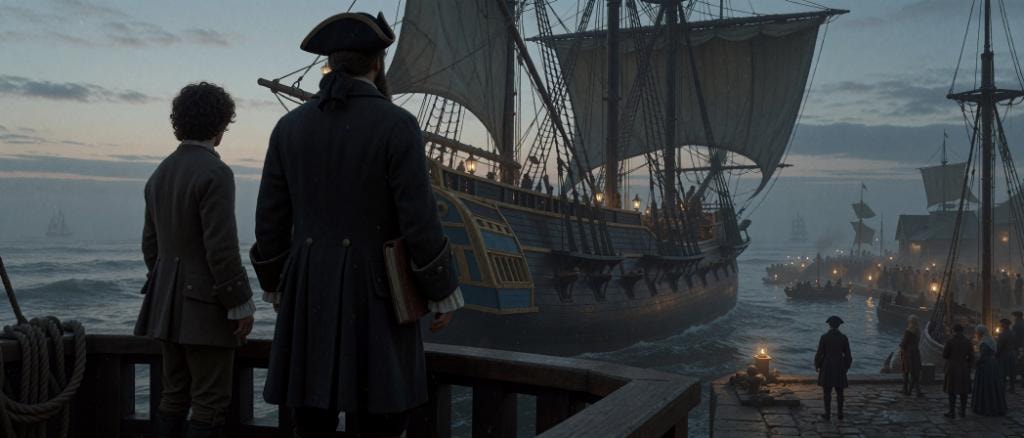
The boy had been aboard for six days before anyone thought to ask why the salt stores kept coming up short.

The boy had been aboard for six days before anyone thought to ask why the salt stores kept coming up short.
It was Sorrel who found him, in the end, not through any great cleverness, but because Sorrel was the kind of man who noticed absences before he noticed presences, and a half-pound of salted pork gone missing from a locked stores cabin was exactly the kind of absence that itched at him until he did something about it. He found the boy wedged into the crawlspace behind the water casks, small enough to have made himself smaller still, dark-haired and hollow-eyed and utterly silent even once the lantern light found him, which told Sorrel more than any amount of struggling would have. A boy who didn't flinch when caught had been caught before.
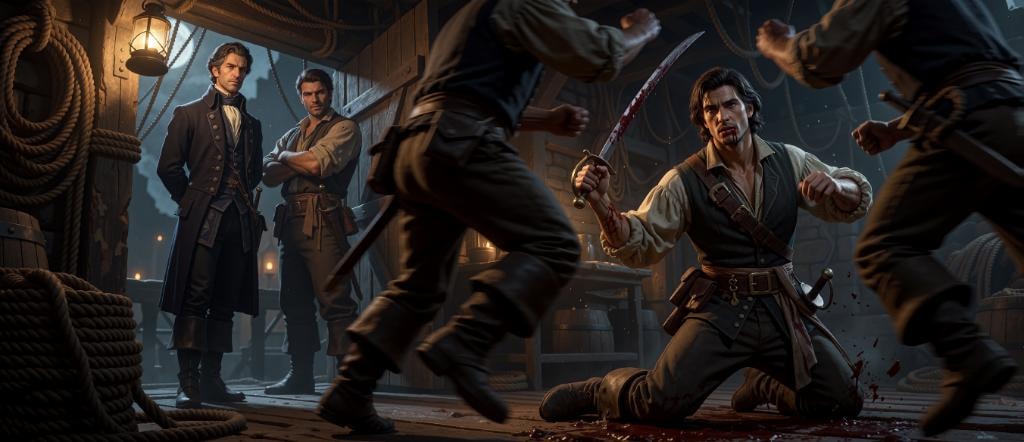
Sorrel dragged him up onto the deck by the collar of a shirt three sizes too large for him, and it was Dutch who laughed first, not unkindly, exactly, the way a big dog might find a smaller animal's fear briefly interesting before losing the thread of it entirely, and it was Cortez who didn't laugh at all, only looked, the way he looked at everything, with the flat, unhurried attention of a man deciding how much a thing was worth to him.
"Stowaway," Sorrel said, unnecessary as an announcement, since the boy's face had already made the case.
"Not a stowaway," the boy said, and his voice came out steadier than a boy that thin and that caught had any right to manage. "A passenger who hadn't paid yet."
Dutch laughed again, louder this time, and even Sorrel's mouth did something that wasn't quite a smile but wasn't nothing either. Cortez did not laugh. Cortez crouched down instead, level with the boy's face, close enough that the boy could see exactly how little warmth lived behind Cortez's eyes, and most boys, most men, for that matter, would have looked away from a thing like that. This one didn't. He held it, the way a man holds a hand he knows is losing, because folding early never won anyone anything either.
"How long," Cortez said.
"Six days."
"And in six days you've taken, what. Pork. Water. A knife off Alvaro's belt he still hasn't noticed is missing." Cortez said this without inflection, the way another man might read a shipping manifest, and the boy's silence at the mention of the knife told Cortez everything he needed to know about where it currently was. "You're not hiding to survive. You're hiding to see what you can take while no one's looking."
The boy said nothing to that, which was, Cortez thought, the first genuinely intelligent thing he'd done since being dragged into the light.
It would have ended there, ordinarily, in the way these things usually ended, a boy thrown over the side within sight of shore if the crew was feeling generous, or simply thrown over the side if they weren't, since a stowaway who ate rations and stole knives was a cost with no offsetting value, and Cortez did not deal in costs without value. But the timing of it, that was the thing that turned an ordinary nuisance into something else, because it was that same week, three days after the boy was found, that the job on the Nuestra Señora went to pieces in a way none of them had planned for.
It should have been simple. A merchant galleon riding low with a cargo of dye and silver, an easy target by every measure Cortez used to judge such things, and they'd taken her clean enough, until a fire meant to disable her rigging had caught somewhere it shouldn't have, in a hold packed tighter with pitch and spare canvas than any of them had accounted for, and what should have been a controlled burn to slow her down became, within the hour, a fire no man aboard either ship could master. Cortez had seen enough burning ships in his life to know within the first ten minutes which fires could still be fought and which could only be fled, and this one told him plainly, the way the tide always told him things plainly if a man knew how to listen: get clear, or go down with her.
He got clear. He always got clear. That was, more than any blade or any coldness, the actual talent Cortez possessed: an instinct for the exact moment a thing had stopped being worth the fighting for, arriving always a beat or two before other men would even admit the question was being asked.
The Nuestra Señora did not survive the night, and neither, entirely, did the ship Cortez's crew had used to take her, struck too many times in the boarding, holed below the waterline in the scramble to get clear, listing badly enough by dawn that Cortez gave the order to abandon her rather than nurse a wound that wasn't going to close. They took what could be carried. They left the rest to the sea, the way they left everything to the sea eventually, and it was in the chaos of that abandoning, men going over the side into boats, cargo being thrown down faster than it could be caught, that Cortez found himself standing, for one unhurried moment, at the rail beside the boy.
The boy was watching the fire the way men watch things they've decided not to feel anything about, which was, Cortez noted with something almost like recognition, exactly how Cortez himself was watching it. Neither of them said anything for a moment. Then the boy did something that surprised Cortez, which was rare enough on its own to be worth noting: he asked a question.
"Are you leaving me?"
Not begging. Not even afraid, particularly, asking, the way a man asks the price of a thing he already suspects he can't afford. Cortez considered him a long moment, the fire painting both their faces the same restless orange, and found, when he answered, that he was telling the boy something closer to the truth than he generally bothered to tell anyone.
"You cost more than you're worth," Cortez said. "You always have. That's not cruelty. That's arithmetic." He nodded toward the barrels being lowered over the side, water casks lashed together in twos and threes for the men who wouldn't fit in the boats. "There's your passage. Take it or don't. I won't be the one deciding which."
He did not throw the boy overboard. That detail would matter later, though neither of them knew it yet, Cortez did not push him, did not order Sorrel to do it, did not so much as raise his voice. He simply turned back to the business of abandoning a dying ship, the way he turned back to every piece of business once he'd decided its outcome no longer required his attention, and left the boy the width of a burning deck and one honest sentence to make his own choice with.
The boy chose the barrels. Cortez knew this only because he glanced back once, from the boat pulling clear, and saw the small shape lashing itself to the casks with a length of rope no man had handed him, working fast and competent in a way that told Cortez the boy had done harder things than this with his hands before tonight.
Cortez did not think of him again after that. He had never been a man who carried the dead, and a boy who might or might not survive the night was, to Cortez's particular accounting, close enough to dead not to be worth the difference. He turned his attention instead to what remained, a burned prize, a scuttled ship, a crew short one vessel and several days' provisions, and, somewhere south along a coast he knew only in fragments, two names still worth more silver than any merchant galleon: Dutch's contact in Nassau, and word, three weeks stale now, of an English captain going by the name Cyphir who had started asking after men Cortez had once counted as safely forgotten.
It was Dutch who broke the silence, once the boats were clear and the Nuestra Señora had gone from a fire to a glow to nothing at all against the dark water.
"The boy," Dutch said. "You could've just let Sorrel handle it days ago."
"I could have," Cortez agreed.
"Why didn't you."
Cortez considered this with the same flat unhurriedness he considered everything, turning it over the way a man turns over a coin to check both faces before deciding it's not worth keeping. "Because he didn't beg," he said finally. "Everyone begs, Dutch. Every last one of them, sooner or later, no matter how hard the shell." He looked back once more at the dark water where the barrels had gone, already lost to distance and current, already none of his concern. "That one didn't. I wanted to see how far a boy like that could get before the sea corrected the oversight."
Dutch said nothing further, because there was nothing further worth saying, and the boats rowed on into a night that had already forgotten the boy entirely, which was, Cortez reflected, exactly the kind of night the sea specialized in, the kind that swallowed small mercies and small cruelties alike without troubling itself to remember which was which.
He did not know, and would have no particular reason to ever learn, that three days later, a hunted merchant captain and his grinning quartermaster would find that same boy still breathing, still calculating, still very much alive, and that the boy he'd left to the sea's judgment rather than his own was about to become the reason the sea's judgment on Cortez himself came due far sooner than he'd planned for.
Continue the pirate serial
ReadChapter Seven: What the Boy Wouldn't SayHow did this chapter find ye?
Written by
Lou Cyphir
Pirate. Storyteller. The Devil's own entertainer. Lou Cyphir sails the Carolina coast and writes dispatches from the black waters — one chapter at a time.