Chapter Seven: What the Boy Wouldn't Say
Vincent ate like a man storing food against a famine that hadn't happened yet, and by the third day aboard the Widow's Debt, Lou had stopped finding it strange and started finding it informative.
Vincent ate like a man storing food against a famine that hadn't happened yet, and by the third day aboard the Widow's Debt, Lou had stopped finding it strange and started finding it informative.
A boy who had never gone hungry ate because he was hungry. A boy who had learned hunger properly, the kind that taught a body to distrust its own next meal, ate the way Vincent ate. Quickly, without conversation, one eye always on the door, as though someone might yet decide the food had been a mistake and come to take it back.
He ate with his left arm curled around the bowl. He tore the biscuit into small pieces and pocketed the ones he couldn't finish, and when he thought no one was looking he checked the pocket twice.
Lou watched him do it for three meals before he said anything. When he finally did, it wasn't a question about the wreckage, or the barrels, or the name the boy still hadn't properly explained. It was smaller than that, and it landed harder for it.
"Who taught you to eat like that."
Vincent's spoon stopped halfway to his mouth. It was the first time in three days Lou had seen him go entirely still, and stillness, Lou had learned watching his own reflection in dark cabin windows more nights than he cared to count, was rarely the same thing as calm.
"Nobody taught me anything," Vincent said. "You just learn it. Or you don't, and then you're not around to unlearn it later."
"That's not an answer."
"It's the only one I've got." The boy resumed eating, slower now, deliberately slower, the way a man paces himself once he's noticed he's being watched. "You want to know where I came from. Everybody wants to know that. Nobody ever wants to hear the actual answer once they've got it."
The galley was close and warm, thick with the smell of salt beef and lamp oil and wet wool. Overhead the deck timbers shifted under the tread of the watch, and the ship's long, slow roll tipped the stew in the bowls first one way and then the other, so that every man at the table was holding his meal level without thinking about it.
Nate, sprawled on the bench against the bulkhead with a length of rope he was pretending to splice, glanced up at that with the particular alertness he reserved for moments when Lou was one wrong word from losing whatever patience he'd been rationing out.
"Try us," Nate said, mild as weather. "We've heard worse. I once knew a man who ate his own boot in a dead calm off Hispaniola. Boiled it first, mind. He wasn't an animal."
It was, Lou thought, exactly the kind of nonsense that worked on frightened men when nothing else would. It worked now. Not enough to break Vincent open, but enough to loosen something at the corner of his mouth that might have been the beginning of a smile before he thought better of it and swallowed it back down with the last of his stew.
He set the bowl aside. He looked at Lou instead of Nate, which told Lou something too. Whatever calculation lived behind those eyes had already decided the captain was the one worth answering to, and the quartermaster was merely the one worth liking.
"I was on a ship," Vincent said finally. "Before the barrels. Not the one you found me on the pieces of, a different one, that I was already off of by the time that one came apart."
He said it carefully, each clause set down like a man testing ice he already suspected wouldn't hold his full weight. He watched to see how much Lou would need before he stopped asking.
"I wasn't supposed to be aboard her at all. I got caught. It didn't go the way you'd think."
"How does it usually go."
"Usually you go over the side."
Vincent said it without weight, the way he seemed to say most things that should have carried some. Lou had begun to understand that this flatness wasn't bravado. It was armor worn so long it had stopped feeling like armor and started feeling like skin.
"The man who found me decided I wasn't worth the trouble of killing. Said I cost more than I was worth. That was arithmetic, he told me. Not cruelty."
The boy's mouth did something complicated, not quite bitter, not quite anything Lou had a name for.
"He wasn't wrong. I did cost more than I was worth. I'm still working out whether that's supposed to bother me."
Nate's rope had stopped moving. He didn't look up from it, and he didn't say anything, which for Nate was a form of respect so rare that Lou nearly missed it.
Lou kept his voice even, the way he had learned to keep it even over four years of coaxing frightened men into telling him things they hadn't meant to tell anyone.
"This man. Did he have a name."
Something shuttered behind Vincent's eyes, fast, the door closing before Lou had even finished the question. For a moment Lou thought he'd lost whatever ground the last hour had bought him.
"Everyone's got a name," Vincent said. "Not all of them are safe to say out loud on a ship you don't know well enough yet."
It wasn't a refusal, not quite. It was something closer to a boy weighing the cost of a word the way he'd once weighed a compass box he had no business touching, turning it over to see what it might buy him and what it might cost him instead. And finding the arithmetic didn't yet favor spending it.
Lou let it go.
He had learned, hunting men for four years, that the ones worth catching were rarely caught by pulling. They were caught by waiting, the way his father had once told him the sea itself worked, patient past all reason, willing to take whatever a man gave up in his own time rather than force the giving.
He stood, and clapped Nate once on the shoulder as he passed, a silent instruction to keep the boy comfortable and keep the questions light. Then he went up to the quarterdeck alone, to look out at water that gave up nothing either, unless a man was willing to wait long enough for it to change its mind.
The afternoon went the way afternoons go on a ship with nothing to chase. Sail trimmed and trimmed again, a hand sent aloft to look at a fraying stay, the cook's boy chased off the quarterdeck twice for trying to sell the helmsman a biscuit. Lou read the water. He read the sky. Twice he caught himself reading the boy instead, from forty feet away, as Vincent coiled line near the main hatch with the same quick, quiet hands that had carried Lou's father's compass across a dark cabin and set it down again without waking a man.
He did not know yet whether those hands were a danger or a gift. He suspected they were both, and that the difference would turn out to belong to whoever Vincent decided to trust.
It was near midnight, the ship quiet but for the working of rigging and the low murmur of the watch, when Lou found Vincent again.
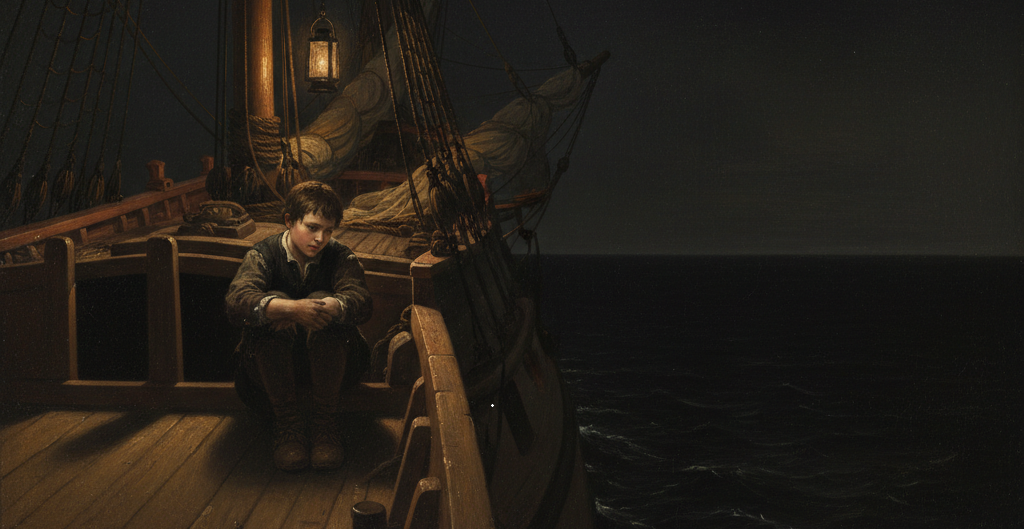
Not below in the crew's hammocks where he was meant to be sleeping, but up near the bow, sitting with his knees drawn to his chest, watching the black water slide by the hull with an intensity that had nothing to do with scenery. The sea was dark and glassy, and where the bow cut it, the wake threw off a faint cold fire that came and went like breath on a window.
Lou didn't announce himself. He simply came to stand beside the boy, close enough to matter, far enough not to crowd.
For a long moment neither of them spoke. A block creaked overhead. Somewhere aft, a man coughed and was shushed. Then Vincent said, without turning his head, in a voice smaller than any Lou had heard from him yet:
"He's out here somewhere. The man from the ship."
He drew his knees in tighter.
"I've been trying to work out how far, and I keep coming up wrong. Because I don't actually know how fast a man sails when he's not being chased by anything. And I never once saw him be anything but unhurried."
He drew a slow breath, and when he finally turned to look at Lou, the calculation in his eyes had cracked open just enough to show something underneath it that looked almost like the age he actually was.
"You're hunting somebody. I've watched you do it for three days. The way you read the water. The way the helm's been held southeast since the hour you pulled me out of it, whatever the wind's been doing. You're not out here for cargo. Cargo men don't look at the horizon like that."
Lou said nothing, which was its own kind of answer. Vincent seemed to take it as permission rather than refusal, because what came next arrived in a rush, like a man finally setting down a weight he'd been carrying since before Lou had ever pulled him from the water.
"If it's who I think it is," Vincent said, "you should know he already knows your name."
Continue the pirate serial
ReadChapter Eight: Three Days BehindHow did this chapter find ye?
Written by
Lou Cyphir
Pirate. Storyteller. The Devil's own entertainer. Lou Cyphir sails the Carolina coast and writes dispatches from the black waters — one chapter at a time.