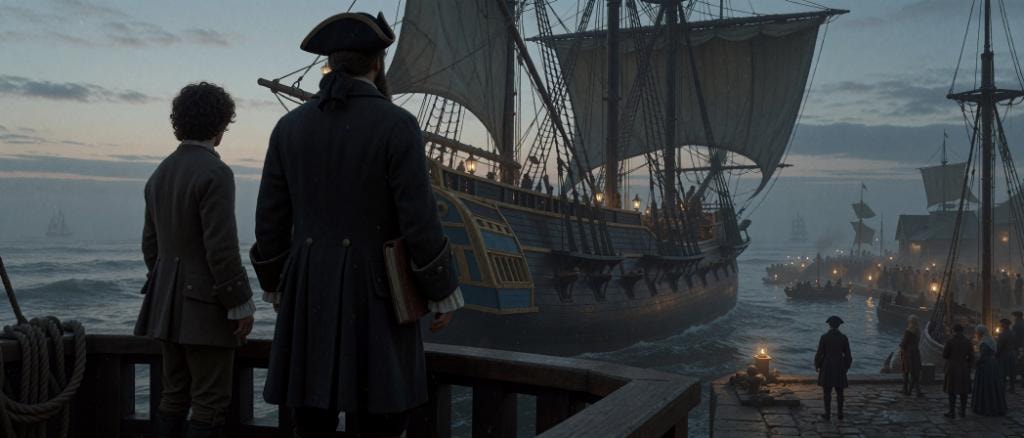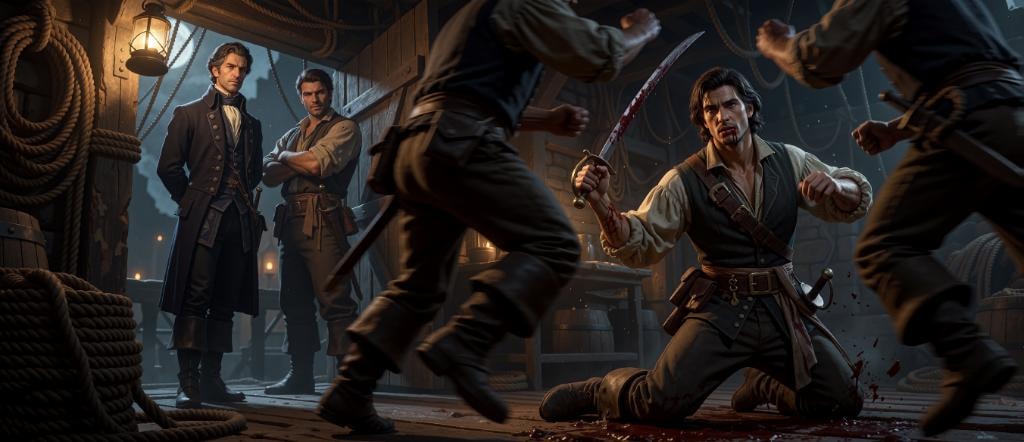
Chapter One: The Moonless Tuesday
There was no moon over the Carolina coast on the night the Cyphir shipyard burned, and Edmund Cyphir would later be praised by men who hadn't been there for choosing that detail as though he'd had any say in it.
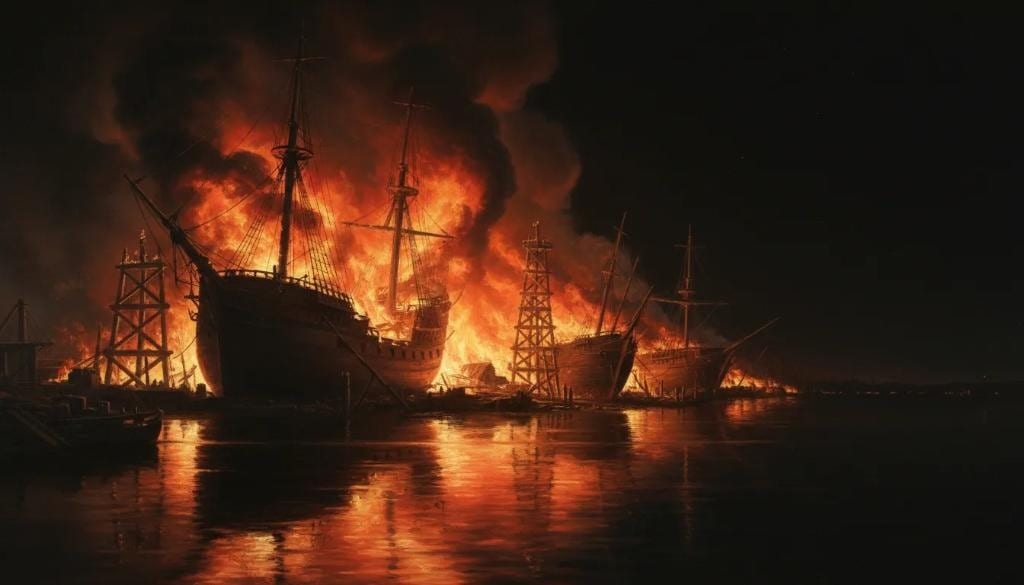
There was no moon over the Carolina coast on the night the Cyphir shipyard burned, and Edmund Cyphir would later be praised by men who hadn't been there for choosing that detail as though he'd had any say in it. He hadn't. He'd simply been awake, a shipwright's habit, checking the drying pitch on a hull he meant to launch within the fortnight, when he heard the wrong kind of quiet fall over the yard. Dogs that should have been barking weren't. That was the first thing. The second thing was the shape of three ships riding at anchor in the cove that had no business being there, flying no colors at all, which was its own kind of answer if a man knew how to read it. Edmund knew how to read ships the way other men read scripture. He set down his lantern, and he went to wake his wife, and by the time he reached the bedroom door the first torch had already gone up against the timber stores.
Margaret Cyphir did not scream. She would tell Lou later, in the fractured way grief tells things, that she remembered being surprised by her own silence, as though some older, colder part of her had already understood that screaming was a luxury for women whose husbands weren't currently arming themselves with a boat-hook and walking toward men with muskets. She begged him once. Just once, by the door, her hand flat against his chest where a small white scar would one day sit on their son in almost the same place, as if the wound were hereditary before it had ever been earned. Edmund kissed her knuckles and told her to bar the door and told her he loved her and told her, God forgive him, that he would be back before the tide turned. Then he went out into the burning yard to die for six warships that had already been paid for and already been stolen, because that was the kind of man Edmund Cyphir was, the kind who went out anyway, knowing the arithmetic didn't favor him, because the alternative was watching from a window while lesser men took what was his.
Lou was in town that night. His father had sent him at dusk with a message for the harbor notary regarding the governor's contract, a task so mundane that Lou would spend years afterward turning it over in his mind, wondering whether some crueler design had simply wanted him elsewhere for the hour it mattered most. He smelled the smoke before he saw the glow, and he ran the two miles back along the shore road faster than he had ever run in his life, faster than he would ever run again, and it still was not fast enough. Three ships were already standing out to open water by the time he reached the ridge above the yard, dark shapes sliding into a darker sea, and below him the shipyard his father had built plank by plank since before Lou was born was a ruin of orange light and collapsing timber. He did not remember the run down the hill. He remembered only arriving.
Edmund lay face-down in the mud between the drying shed and the water, close enough to the tideline that the sea had already begun creeping up to touch him, indifferent, the way his father had always said it would be. There was a boat-hook still in his hands. There was very little of him left that had not been taken by musket or knife or the particular violence of men who had done this kind of work before and intended to do it again elsewhere before the season was out. Lou knelt in the mud beside him and found that his hands, when he reached for his father's shoulder, were perfectly steady, a stillness that frightened him far more than shaking would have, because he understood even then, at nineteen, kneeling in the wet ash of everything he'd been raised inside, that something in him had just finished changing shape and would not be changing back.
Margaret was found unharmed, in the strict and useless sense of the word, sitting exactly where Edmund had left her, the bar still across the door. She did not weep when they told her. She asked, with a courtesy that undid Lou more than any collapse could have, whether the men had taken the deed along with the gold, because if they had, she said, there would be papers to file with the colonial office by week's end, and someone needed to see to it. Lou saw to it. Lou saw to everything, that autumn and the long gray winter that followed the burying, the debts, the notary, the men at the tavern who offered condolences with one side of their mouths and asked after the property with the other. He learned, in those months, precisely which of his father's friends had been friends and which had merely been men who liked the look of Edmund Cyphir's coin. It was an education his father would have approved of, delivered in the worst possible way.
His mother lived fourteen months past that night, though calling it living required a generosity Lou eventually stopped extending, even to her, even in his own private accounting of things. The physicians examined her lungs, her heart, the color of her blood, and pronounced her sound, which Lou came to understand was the cruelest possible diagnosis, proof that whatever was killing her had no name a physician could treat.
There was a morning in the seventh month, he remembered it as the seventh, though he could no longer have said why that one stayed and the others blurred, when he brought her tea and found her already dressed and already seated at the window, as though she'd been there since before first light. He set the cup by her hand. She did not lift it. Steam went on rising and thinning and finally stopped, and still she didn't reach for it, and Lou stood in the doorway a long moment not because he expected her to speak but because some part of him kept waiting for the version of his mother who would have scolded him for letting good tea go cold. That woman did not appear. The woman in the chair only went on watching the blackened yard below, and after a while Lou took the cup away himself, untouched, and did not mention it, and she did not ask him to.
That was the shape of the fourteen months, more or less, repeated with small variations he stopped bothering to distinguish from one another. She ate when he put food in front of her. She answered when spoken to, with the same iron courtesy she'd always had, only quieter now, worn thin as a coin passed through too many hands. And in the gray hours before dawn, more mornings than Lou ever told her he'd counted, he found her at that same window, watching the place where her husband's life's work had stood, as though watching hard enough might yet rebuild it.
She stopped on a Sunday morning in December, sitting in that same chair, hands folded in her lap with a composure that made the physicians' report read almost like comedy, heart failure, they wrote, as though a heart could fail on its own schedule and not simply run out of reasons to keep going once the thing it loved most had been taken from it in the mud. Lou buried her on the hill above the ruined yard, beside the husband she'd followed there in every way that mattered fourteen months before the ground finally agreed to do it in fact. He did not weep at the grave. He had done his weeping already, alone, through a hundred gray mornings of watching her fade one silence at a time, and there was nothing left in him that the burial could wring out that hadn't already been wrung.
What he felt instead, standing on that hill with the wind coming cold off water that had swallowed his father and outlasted his mother's grief without so much as a ripple to show for it, was something he would spend the rest of his life learning to live inside of. Not sorrow. Sorrow, he understood even then, was a debt you paid once and were done with. This was different, colder, and considerably more patient.
It did not announce itself as anything in particular, that first year. It simply sat in him the way ballast sits low in a hull, unseen, felt only in how the ship rode the water in the steadiness of his hands at the burying, in the particular quiet with which he'd begun asking questions in taverns and shipping offices, questions that sounded, to the men answering them, like nothing more than a grieving son's idle grief. It was months before Lou understood that the thing sitting in him had a shape at all, and longer still before the shape had a name.
But it did, in the end, have a shape. In the months of quiet asking that a grieving son could get away with, in taverns and shipping offices and the back rooms of men who owed his father favors, Lou had learned one name, and the outline of two more men standing behind it. Not proof. Not yet. But a name, spoken low by men who'd heard other men speak it lower still, belonging to a captain who took contracts from a Spanish crown that wanted English settlements weakened and English gold rerouted into other pockets. Rafael Cortez was that name. There would be time enough to learn the other two properly, later, at sea, where debts like his eventually came due.
How did this chapter find ye?
Written by
Lou Cyphir
Pirate. Storyteller. The Devil's own entertainer. Lou Cyphir sails the Carolina coast and writes dispatches from the black waters — one chapter at a time.