Chapter Five: What the Sea Gives Back
The wreckage came up out of gray water like something that had been chewed apart rather than sunk. Lou watched it a long moment through the glass before he said anything at all.
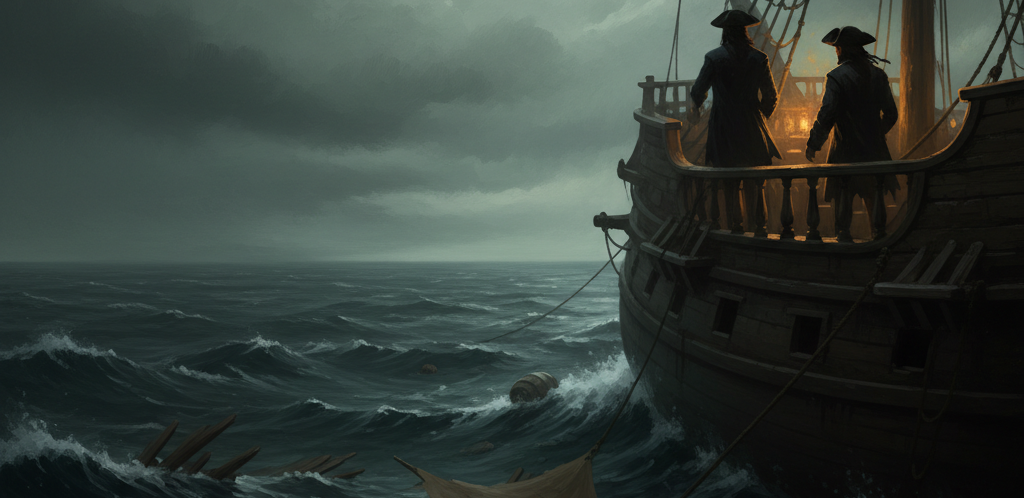
The wreckage came up out of gray water like something that had been chewed apart rather than sunk, barrels, a dozen or more, riding low and lazy on the swell; splintered planking too small to belong to anything but a rail or deck housing; a sail, or what had been a sail, tangled and half-submerged, drifting the way a drowned thing drifts when it hasn't yet accepted it's dead. Lou watched it a long moment from the rail before he said anything at all, and when Nate asked what he made of it, his answer came out sharper than he intended.
"We're not stopping," he said. "Note it in the log if you like. Somebody's boat came apart out here. Somebody's boat comes apart somewhere in these waters every week of the year. It's not our business, and Cortez isn't going to wait around to see if we've got a conscience."
"That's not a wreck," Nate said, unbothered by the tone, still squinting at the water the way he squinted at things Lou had already looked at properly. "A wreck's got a hull in it somewhere. That's just... leftovers."
"That's the word for it." Lou didn't look away, because there was something in the pattern of it that had started to bother him the longer he looked, and he wanted the extra few seconds before he had to say why. His father had taught him to read a hull the way other men read a face, and what he was reading here didn't sit easily. Rot took a ship slow and from the inside, planking gave first at the seams, not at the rail, and a rotten hull didn't scatter its barrels in a clean line like that, still roughly grouped, still riding close enough together that they'd drifted as a unit rather than a wreck's usual scatter. This wasn't a ship that had given up to age or weather. Something had opened her along the beam, hard and sudden, and whatever had done it hadn't cared much for what floated free afterward, except, apparently, for the barrels closest to whatever poor soul had been lashed to them.
It had been three days since Nassau, three days of favorable wind and a heading Lou had plotted off nothing but instinct and the fragments the privateer in the market square had let slip before Lou's fist had made further conversation unnecessary, three days that had put them close enough to the second name on his list that Lou could feel it now the way a man feels weather coming, a pressure behind the eyes that hadn't left him since Nassau. Every hour they weren't closing that distance was an hour Cortez's crew had to hear a rumor, take fright, change course, vanish back into the hundred ports and coves that made this whole stretch of coast a labyrinth built specifically to swallow men who wanted finding. Lou had chased ghosts before. He had no appetite for chasing another one because his own crew had stopped to gawk at driftwood, and it was that thought, more than any concern for what the wreckage actually meant, that had put the edge in his voice a moment before.
Nate didn't answer right away, which was itself unusual enough that Lou finally turned from the rail to look at him. Nate wasn't looking back. He was looking past Lou, out at the debris field, with an expression Lou had seen on him only a handful of times since they had first sailed together, the look he got right before he did something Lou would spend the next hour being furious about.
"There's someone on the barrels," Nate said.
Lou's head snapped back toward the water so fast he nearly lost his footing at the rail.
It took him a moment to find what Nate had already seen, a shape lashed across two barrels roped crudely together into a raft that wouldn't have held a grown man's weight for an hour in any real chop, and even at this distance Lou could tell the shape wasn't grown. Small. Curled in on itself the way the cold makes a body curl, one arm hooked through the rope work like it had been tied there on purpose, or like whoever tied it had wanted to make sure the sea took the barrels and the boy together or not at all.
"Lou." Nate was already moving toward the boats, and there was none of the easy grin in his voice now, none of the boyhood theater, just flat, fast urgency, the same voice he'd used the day a topsail yard had come down on a deckhand off the Carolina coast and Nate had been the first one under it. "Lou, we have to..."
"I know what we have to do," Lou said, and was already giving the order before Nate finished asking for it, because whatever frustration lived in him about Cortez and the tide and the hours they were bleeding did not, could not, extend to leaving a child to drown for the sake of a schedule. He was his father's son in that much, at least, whatever else the last five years had worn away from him.
The boat covered the distance in what felt to Lou like both no time at all and considerably too long, the debris field opening up around them as they rowed through it, a child's shoe, waterlogged and alone, a crate stamped with markings Lou didn't recognize, split staves from what had probably been a water cask, and everywhere the barrels, still holding that same rough formation, as though whatever violence had broken the ship apart had spared this one small cluster on purpose. Lou put that thought aside. It could wait.
The boy was alive. That much was clear before they'd even come alongside, a cough, thin and racking, followed by a full-body shudder that told Lou more about how long he'd been in the water than any question could have. He couldn't have been more than fifteen, small enough that the rope lashing him to the barrels had wound twice around a frame that looked like it had never had much flesh on it to begin with, dark hair plastered flat and colorless with salt, lips gone the particular blue-gray that Lou had seen exactly once before, on a sailor pulled from a winter harbor two years back, a man who had lived only because they'd gotten brandy into him before his heart had made its decision permanent.
"Easy," Nate said, already leaning over the gunwale with both hands out, all the theater back in his voice now but softer, the register he used on frightened horses and frightened men, which as far as Lou had ever been able to tell were the same animal to Nate. "Easy now. We've got you. Nobody's letting go of anything."
The boy's eyes opened at the sound of a voice that wasn't the sea's, and what was in them wasn't relief, not yet, it was calculation, quick and startlingly clear-headed for a half-drowned child, an assessment of the two faces above him that Lou recognized because he'd worn that same look himself once, kneeling in mud on a Carolina hillside, deciding in the space of a breath which of the men standing over him could be trusted and which couldn't. Whoever this boy was, Lou thought, the sea hadn't taught him that particular caution. Somebody else had, a good while before tonight.
They got him aboard the Widow's Debt wrapped in every dry blanket the ship possessed and poured enough watered rum into him to make his teeth stop chattering, and it was a full hour before he spoke a word that wasn't a cough, and when he did speak, it wasn't gratitude.
"Where's your captain," he said, voice cracked to nothing but the words themselves clipped and certain, the words of someone used to being the one who asked questions rather than answered them.
"You're looking at him," Lou said.
The boy's eyes moved over him quick and specific, not the coat first, the way most men looked at a captain, but the hands, then the boots, then the scar showing where Lou's shirt had shifted at the collar, cataloguing each in turn the way a man might check a purse for the coins that mattered before bothering with the ones that didn't. "You don't look like much," the boy said finally, "for someone who's killed people."
Nate laughed out loud, delighted. "Oh, I like him."
"You would," Lou said, and did not smile, because something about the boy's stillness, that same too-quick calculation, that refusal to be grateful on cue, had put him on guard in a way the drowning itself hadn't. A boy alone on wreckage in open water, roped to barrels by someone who'd wanted him found, was either the luckiest survivor Lou had ever pulled from the sea or the only piece of a much larger story that had washed up first. "What's your name."
"Vincent," the boy said, and offered nothing else... not a ship, not a family, not a reason a boy his age had been alone on the water with barrels lashed around him like a coffin that hadn't finished its work. Just the one word, flat and final, the way a man gives up a name he's decided is safe to give and nothing more.
Lou looked at him a long moment, and then at Nate, who was already crouched down refilling the boy's cup like he'd adopted a stray dog and intended to keep it whether the captain approved or not, and felt, underneath the frustration that hadn't left him since the lookout first called the debris field, a colder and more familiar unease settling into its place instead, the sense, honed over four years of hunting men who didn't want to be found, that whatever had put Vincent alone on that wreckage was not an accident the sea had made on its own.
"He stays till the next port," Lou said, which was as much ground as he intended to give tonight. "After that, we'll see."
Nate grinned like he'd already won an argument three ports down the line, and Vincent said nothing at all, only watched Lou with those same quick, careful eyes, the eyes of someone doing sums Lou couldn't yet see the total of, and it was that stillness, more than anything else about the boy, that told Lou the two hours he'd just spent looking for a child on the water had cost them more of Cortez's trail than he wanted to admit, and that the losing of it was very likely not the last thing this night was going to cost him.
It was near midnight when Lou went below himself, meaning only to check the boy was still breathing and not planning to be gone before dawn. The cabin was dark enough that he navigated it by memory rather than sight, one hand finding the shelf above his bunk out of long habit built into the wood itself rather than his own life, and it was that same habit that told him something was wrong before his eyes could confirm it. The tin box that held his father's compass, the one that never left that shelf, wasn't where his hand expected it. He stood a moment in the dark with his fingers on empty wood, feeling something cold move through him that had nothing to do with the night air, and then he found it... six feet across the cabin, tucked beneath a folded blanket that hadn't been anywhere near it an hour before, not hidden so much as placed, the way a man sets down something he's finished examining.
Nothing was missing. That was the part that stayed with Lou longest, crouched there in the dark with the box in his hands, turning it over to find every latch still closed, every hinge still true. Nothing was missing, nothing was broken, nothing was even out of place beyond the simple, impossible fact of having moved, as if the boy hadn't wanted the compass at all, only wanted to know, in the dark and half-drowned and surrounded by strangers, whether he still could.
Lou stood a long while in that cabin before he went back up, turning the thought over the way he turned over cargo weights and current lines, all the small measures that kept a ship and a man both afloat. A boy who stole from men who'd just pulled him from the sea, and took nothing, and left no mark of it but the moving, that wasn't the seed of a thief. That was the whole tree, already grown, already patient, already better at this than boys twice his age had any right to be.
Whatever Vincent was running from before the barrels found him, Lou thought, closing his hand once around the cold brass of the compass case, it had not taught him how to disappear. Not yet. But it had taught him everything else first, and Lou intended to find out, before this voyage was done, exactly which of those two things would matter more.
Continue the pirate serial
ReadChapter Six: What Cortez Leaves BehindHow did this chapter find ye?
Written by
Lou Cyphir
Pirate. Storyteller. The Devil's own entertainer. Lou Cyphir sails the Carolina coast and writes dispatches from the black waters — one chapter at a time.