Chapter Eleven: A Father's Hand
A letter from Edmund Cyphir and an iron ring pull Lou toward an old debt—and a hunter in the storm.
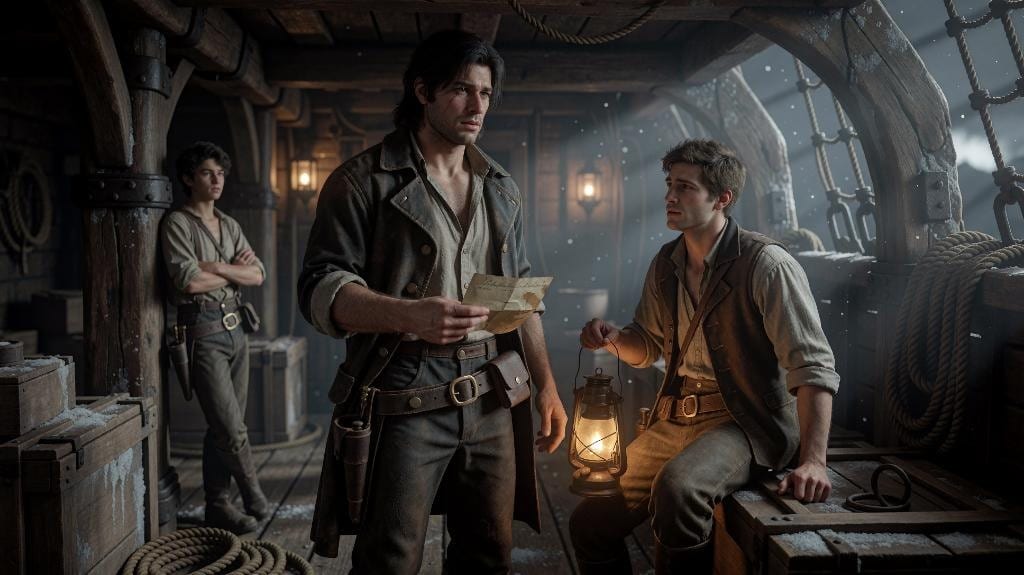
The crate had been nailed shut twice, once by a careful hand and once by a careless one, as though someone had sealed it and someone else had checked the seal without trusting it. Lou worked the second set of nails free with the flat of his knife while Nate held the lantern close enough that the pitch on the wood caught the light like wet tar. Vincent stood a step back, arms folded, watching Lou's hands instead of the crate itself, the way he watched most things that mattered to him. Above them the ship had started to complain in earnest, timbers groaning under a swell that was building faster than any of them wanted to admit.
Inside, wrapped in oilskin gone stiff with salt, was a bundle of papers, and beneath them, wrapped separately, a plain iron ring. Lou did not reach for the ring first. He cut the cord on the papers instead, and the top sheet nearly took the breath out of him, because he knew that hand. He had watched it sign bills of sale and correct his own boyhood letters more times than he could count. It was Edmund's, unmistakably, each letter formed with the same deliberate economy he had brought to everything.
The letter was dated four months before the raid, addressed to Josiah Kell. Lou read fast, the way a man reads bad news, wanting it over before it could finish landing. Edmund had heard of movement along the southern routes, three captains buying favor with a foreign crown, and trusted no one in the colonial office enough to bring it to them directly. He had written that Kell would know who to ask, because Kell had sailed those same waters himself, on the wrong side of the law, and owed Edmund a debt he'd never once spoken of to his own son. Then the page went wrong. Water had gotten into the wrapping at some point in the last five years, enough to bleed the ink across two full lines right where the letter should have named the debt outright, leaving only broken words, a fragment that might have read the boy or might have read something else entirely, and then nothing legible until Edmund's signature at the bottom.
"What's it say," Nate asked, and Lou realized he'd gone silent long enough to worry him.
"It says my father knew," Lou said. His voice caught on the last word, an almost imperceptible break that vanished as fast as it came, and when he lifted the page again there was a fine tremor in his hand that hadn't been there a minute before. "Four months before they killed him. And it says Kell owed him something he never paid back in five years of drinking at my table." For an instant his father's voice cut clean through the sound of rain on the deck above, unbidden and oddly specific: Edmund's hand closing over his own on a length of wet rope the winter Lou turned twelve, patient in a way the man rarely allowed himself to be, telling him a bowline was a knot you tied once and trusted with your life, same as a man's word. He hadn't thought of that in years. He set the memory aside the way he set aside most things that threatened to slow him down, though it plainly cost him more than he let show.
A shout came down from above before Nate could answer, sharp and urgent in a way that cut clean through the mood in the hold. Sail spotted, running dark, closing fast on their stern. Lou was moving before he'd finished thinking about it, shoving the letter inside his coat rather than setting it down, and Nate was right behind him. Vincent didn't move as fast. He crouched instead, just long enough to close his hand around the iron ring Lou had left behind, and when he straightened his face had lost the careful blankness he usually wore. "I've seen this mark," he said, low, mostly to himself, turning the band so the etching inside it caught the light. He didn't explain further, not with the deck already coming alive with shouted orders overhead, and when Lou called back for him to move, he pocketed the ring without a word and followed.
On deck the wind had teeth in it now, rain coming sideways in cold sheets that stung where they hit bare skin. The dark sail behind them had grown close enough to make out the shape of her hull cutting the swell, low and fast, riding no colors, gun ports cut low along her side. For one instant a stroke of lightning threw her whole silhouette into hard white relief, long enough for Lou to catch, just below her bowsprit, the ghost of a painted mark he did not have time to place before the dark swallowed her again. It looked, absurdly, like a coiled shape biting its own tail. He told himself the light had lied to him. He was not entirely sure he believed it.
He said nothing of it to Nate. Telling himself there would be time enough to chase a shadow, if the storm proved him right, was easier than admitting the truer reason. Naming what he thought he'd seen meant naming who he suspected wore marks like it, and he was not ready to say Kell's name to anyone as an accusation rather than a question.
"She's gaining," Nate said, not a question.
"She's gaining because she wants to," Lou said, and handed the glass off. "That's not a merchantman running scared of weather. That's a hunter who's decided we're worth the trouble." He looked up at Sorrel's rigging, unfamiliar under his hands in ways his own ship's never was, and did the arithmetic every captain does in the space between one heartbeat and the next: how much canvas the storm would allow, how much speed that bought them, whether it was enough. It wasn't, not on this heading. "Bring her two points to starboard. If we can't outrun her in a straight line we'll make her work for the angle."
The crew moved the way a crew moves when they've already decided panic won't help them, fast and short-tempered and efficient. Vincent found himself hauling on a line beside a man twice his size, soaked through in seconds, and in the brief lulls between orders his hand kept finding its way to the pocket where the ring sat, as if checking it hadn't dissolved along with everything else that had felt solid an hour ago.
The dark ship closed another half mile before the course change bit, and for a stretch of minutes that felt considerably longer than it was, nobody spoke at all except to shout instructions. Then, with a suddenness that surprised everyone who hadn't spent years reading weather the way Lou had, the storm did them a favor it hadn't intended. A squall line rolled across the gap between the two ships, thick enough to swallow a hull whole, and Lou gave the order to cut hard through it rather than around, trusting his own read of the wind over the risk of the blind water. Nate didn't ask twice. For three full minutes the world was nothing but roaring gray and the groan of timber and Lou's voice counting a heading aloud to the man at the wheel like a man praying in the only language he actually believed in.
When they came out the other side, soaked to the bone and half-deaf from the wind, the dark sail was gone. Not sunk, not surrendered, simply gone, swallowed by weather and distance and whatever luck the sea had decided to spend on them tonight instead of on the men behind them. Nobody cheered. They were all too tired and too aware that gone wasn't the same as finished.
It was another hour before Lou went below again, the deck secured as much as it could be secured, the storm settling into the kind of steady misery that would last till dawn rather than the kind that killed ships outright. He found Nate waiting for him near the crate, and Vincent a few feet off, sitting on an overturned barrel with his forearms braced on his knees, looking like a man working up to something.
Lou took the letter back out, laying it flat on the crate lid where the lantern light could reach every inch of the ruined middle section one more time, as if staring at it long enough might make the water give back what it had taken. "I keep thinking if I read it enough times the ink will remember what it used to say," he admitted, and it cost him something to say it out loud.
"Might not need the ink," Vincent said.
Both of them looked at him. He held the iron ring up so the lantern caught the shape scratched into its inner band: a small coiled thing, biting its own tail, with three short notches cut around its edge like a tally mark. "Men who wear this call it the Undertow," he said. "I've seen it twice in my life, both times on men who dealt in debts nobody was ever meant to put on paper. Once you take a ring like this, you're marked as owing." He turned it slower, thumb tracing the three notches. "These, I'm not certain of. Could be debts still unpaid. Could be men who died collecting on somebody else's behalf. Could be voyages, for all I really know — I only ever had the mark itself explained to me, never the counting." He looked up, and for once his uncertainty seemed to cost him more than his usual silences did. "What I do know is this isn't merely the same mark I saw before. This is your father's ring. It was in his crate, wrapped like something worth hiding. However he came to hold it, he was tied into the same kind of debt as whoever else carries one, whether he wanted to be or not."
Lou stared at him for a long moment, rain still dripping off his hair onto Edmund's ruined handwriting. He thought of the shape he'd glimpsed on the hunter ship's bow in that one flash of lightning, coiled and biting its own tail, and thought about telling them, and didn't, not yet, unwilling to hand Vincent one more thread to pull at until he knew for certain whether that shape had truly been the Undertow or only a trick of the storm.
"Then I think," Lou said quietly, "you and I are going to have a much longer conversation than the one I was planning to have with Kell."
How did this chapter find ye?
Explore Topics
Written by
Lou Cyphir
Pirate. Storyteller. The Devil's own entertainer. Lou Cyphir sails the Carolina coast and writes dispatches from the black waters — one chapter at a time.