Chapter Thirteen: Ripe on the Vine
A crate of overripe peaches opens an old wound aboard the Widow's Debt, while Vincent warns Lou that another hunter is drawing near.

The cargo they'd taken off a coastal trader three days out of Governor's Harbor was mostly what a man expected from a run like that, salt fish, bolts of undyed cloth, a crate of nails that Nate had already claimed for the ship's own repairs before anyone thought to argue the point. It was Vincent, going through the last of the manifest by lantern light, who found a small crate of fruit packed loose in straw near the back of the hold, one that matched nothing on the manifest and that no one aboard remembered loading, and it was Lou, passing behind him on his way to check the pumps, who caught the smell of it before he'd even seen what it was.
He stopped walking. He didn't mean to. His feet simply quit moving of their own accord, the way a man's body sometimes knows a thing before his mind has caught up to naming it, and for a moment he stood there in the narrow passage between crates with no reason he could put words to.
"You've gone strange," Nate said, coming up behind him with a coil of line over one shoulder. "What is it."
"Nothing." Lou said it too fast, and Nate, who had known him too long to accept that particular tone at face value, only raised an eyebrow and waited, the way he always waited when he knew a better answer was coming eventually whether Lou wanted to give it or not.
Vincent lifted one of the peaches out without being asked, turning it once in the lantern light the way he turned over most things that came into his hands, testing its weight before he trusted it. It was soft enough to bruise under a careless thumb, the skin split faintly along one side where the straw had pressed too hard against it in the crate, and the smell that came off it, warm and sweet and a little too ripe to last the week, was not a smell Lou associated with cargo holds at all, not anymore, because he had smelled that same overripe sweetness once before, on a woman's hands in a market stall in Governor's Harbor, juice running down her wrist from a peach she'd bitten into without once pretending she cared whether anyone was watching her enjoy it.
He hadn't thought about Brigid in days. He had told himself that plainly, more than once, the way a man tells himself a great many things he only half believes. And now here he was, standing in a cargo hold three days and however many miles removed from that dock, brought up short by a piece of fruit that had nothing at all to do with her, except that somewhere in him there was apparently a box he hadn't known he was keeping, small and shut and never once opened on purpose, and some careless part of him had gone and put her inside it without asking his permission first.
"Lou." Nate's voice had lost its teasing edge, gone quieter, the way it did when he'd actually worked something out rather than merely guessed at it. "You're doing the thing again."
"What thing."
"The thing where you go somewhere else behind your own eyes. Vincent called it first, but I've seen it plenty since." Nate set the coil of line down on a crate, unhurried, the posture of a man settling in because he had no intention of dropping this until he got somewhere with it. "It's the peach, isn't it."
Lou didn't answer right away, which was answer enough for both of them. Vincent, to his credit, said nothing at all, only went back to cataloguing the rest of the bundle's contents with the particular tact of someone who understood that some conversations were not his to referee, though the faint set of his mouth suggested he was enjoying this more than his silence let on.
"She was eating one," Lou said finally, because there was no use pretending otherwise once Nate had already named the thing correctly. "Wouldn't have thought anything of it at the time. Just a woman enjoying her lunch in a market full of people trying not to enjoy anything too openly." He turned the peach over once in his own hand, testing the weight of it, though there was nothing about a piece of fruit that should have required testing at all. "It's strange, what a man's memory decides to keep. I couldn't tell you the color of the kerchief she wore. I could tell you this, though, clean as if she were standing in front of me."
"That's usually how it goes," Nate said, and something in his voice had gone unusually gentle for a man who spent most of his waking hours making a joke out of everything within reach. "Wasn't like that for me and Isabela, if you're wondering. I remembered the sound of her laugh before I remembered much else. Everybody's got their own way of being ambushed by it."
"I'm not being ambushed by anything."
"You went quiet in a cargo hold over a peach, Lou. Call it whatever settles easier with you, but don't ask me to agree it isn't what it plainly is." Nate picked the line back up, slinging it over his shoulder again, though he didn't move to leave just yet. "For what it's worth, and I know you didn't ask, she told you plain enough where she stood on pirates. Didn't leave much room for guessing. But a woman doesn't warn a man off twice as hard as she needs to unless some part of the warning's meant for herself as much as for him."
Lou considered that longer than he meant to, standing there in a hold that smelled now of salt fish and undyed wool and, faintly, underneath it all, of ripe fruit that had no earthly business meaning anything to him at all. He thought of her standing a step behind Isabela with her arms folded, sizing him up the way a woman checks a horse she has no intention of buying, and of the flat, unbothered way she'd told him to put away whatever was crossing his face before he'd said a single word to earn the warning. He thought, too, of the particular economy of her attention, the way she hadn't bothered performing either interest or dislike, and how that plainness had unsettled him more than any amount of flattery ever could have, because flattery he knew exactly how to answer and this he did not.
"There's a difference," he said at last, quiet, mostly to himself, "between not today and no."
"You said that on the dock too," Nate said. "Word for word, near enough. Man doesn't repeat a thing like that by accident."
Lou didn't have an answer for that either, and Nate, sensing correctly that he'd gotten as much out of his captain as the evening was going to allow, let it drop with a grin and went back to his line, humming something tuneless under his breath that Lou suspected, though he didn't ask, was meant to sound like a woman's laugh if a man squinted at it with his ears instead of his eyes.
Vincent waited until Nate had gone up the ladder before he spoke, low, not looking up from the manifest he was still working through by lantern light. "You could put in at Governor's Harbor again," he said. "It's not far off our heading, if you wanted an excuse that wasn't really about rope or water."
"We don't have an excuse that isn't really about rope or water," Lou said. "We have a rendezvous point to reach, a week or so out and closing, and a man on the other end of it who's already had four years' head start on forgetting to be careful."
"Didn't say drop the rendezvous." Vincent finally looked up, and there was something almost amused in the look, rare enough on him that Lou noticed it the way he noticed most things Vincent rarely gave away for free. "Said it's not far off the heading. A man can want two things at once, Captain. I'd have thought you'd worked that out by now, chasing one debt for four years and letting Nate chase a woman the whole time alongside it."
Lou didn't answer that either, but he set the peach aside on the crate rather than back in with the rest, and if Vincent noticed the small deliberateness of it, he had the good sense, for once, to say nothing at all.
He found Nate topside a short while later, and neither of them needed to say out loud where they were headed next. Sorrel had been twelve days in the small locked storeroom they'd converted into a brig, fed enough to keep him upright and not a mouthful more, and Lou had let him sit in his own silence that long on purpose, the way a man lets a wound sit before he decides whether to cut deeper or let it close on its own. Tonight, with the rendezvous drawing closer and the letter still sitting unanswered in his coat, Lou had run out of patience for letting it close.
Sorrel looked up when the lantern light hit him, squinting against it with the particular defiance of a man who had decided early on that showing fear cost more than it was worth. He hadn't shaved in the days since his capture, and the cut along his jaw from the boarding had scabbed dark and ugly in the damp air of the hold, but his eyes were as sharp as they'd been the day Lou pulled the name out of him at the point of a sword.
"Come to ask me the same question again," Sorrel said, "hoping I'll answer it different this time?"
"Come to ask you a few new ones." Lou crouched down so they were level, close enough that Sorrel could see exactly how little patience remained behind his eyes. "The rendezvous point. Three weeks out, your own captain's hand in the manifest. You're going to tell me what's waiting there."
"Am I."
Nate crouched down on Sorrel's other side, and there was none of his usual looseness in it, none of the grin he wore for Isabela or for frightened deckhands he was trying to put at ease. What was left when Nate stripped that away was something colder than Lou's own manner, precisely because it was so unfamiliar on him, a kind of pleasant, patient menace that unsettled men far tougher than Sorrel had ever needed to be. "You know," Nate said, conversational, almost friendly, "I've sailed with this man since we were twenty-one, and I've watched him take apart stronger men than you without breaking a sweat over it. Difference is, he does it quick, out of some notion of mercy he still can't quite shake, whatever it's cost him. Me, I've got no such notion left in me. Never did, if I'm honest. So you can answer him, or you can find out which one of us you'd rather be dealing with instead."
Sorrel's jaw worked, and for the first time since his capture something like real calculation crossed his face rather than mere defiance. "You'd have done it already if you meant it."
"We would," Lou agreed. "Which should tell you something about how close you're standing to us finally deciding it's worth the trouble." He let that sit a moment, let Sorrel do his own arithmetic with it, before he went on, quieter now, no less hard for the lowered volume. "You watched my father die. You stood there in that yard and did nothing to stop it, or you helped do it yourself, and either way you've had nearly five years to enjoy the silver you took off him while I learned to hate patiently enough to find you. I am not a merciful man where you're concerned, Sorrel. I only look it, because looking it costs me less than showing you what's actually underneath."
Something in Sorrel's face shifted then, not quite fear, but something adjacent to it, the recognition of a man realizing the ground under him wasn't as solid as he'd told himself it was. "The rendezvous," he said slowly, "is a resupply. Nothing more dramatic than that. A cove east of the passage, provisions and powder traded off a contact who doesn't ask questions about where either comes from." He stopped there, and Nate's hand closed, unhurried, around the hilt at his belt, a small motion that said plainly enough what would happen if the sentence ended there.
"There's more," Lou said.
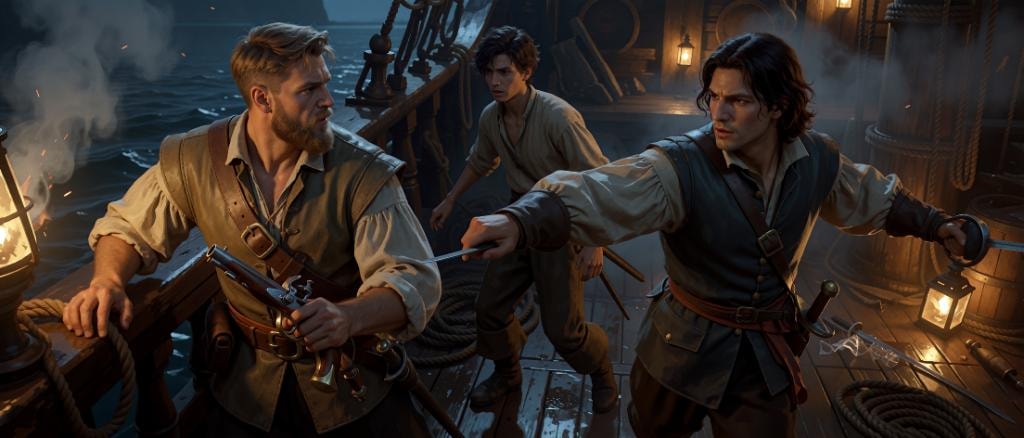
"There's a second name," Sorrel said, and his voice had gone flatter now, the fight going out of it the way it goes out of a man who has finally done the sum and found the answer he didn't want. "Dutch Aariq. He'll be there before Cortez, most like, he always arrives first to check the ground's clean. Big man, quiet, carries a flintlock pistol he's better with than any blade, the kind of piece that costs more than most men on that ship have seen in a year, which should tell you plainly enough how much Cortez trusts him. You go in loud, you'll lose the advantage of surprise you're clearly counting on, and Dutch doesn't panic the way lesser men do when the shooting starts."
Lou absorbed that without letting it show on his face, filing it away alongside the letter and the ring and every other fragment he'd collected since the shipyard burned. "And Cortez himself. Where does he go once the resupply's done."
"That," Sorrel said, and something almost like satisfaction crept back into his voice, thin as it was, "I genuinely don't know. Cortez doesn't share his own course with men he considers expendable, and I promise you, Captain, I have never once been anything more than that to him." He looked up, meeting Lou's eyes squarely for the first time since the questioning began. "You want to know something true, for whatever it's worth to you? He wouldn't have crossed a room to save me, the day your father died or any day since. Whatever debt you think you're owed from me, he owes you a hundred times worse, and he's spent every day since making sure other men pay the smaller half of it in his place."
Nate straightened up, some of the coldness easing out of his posture now that the answers had actually come, though his voice kept its edge a moment longer. "That supposed to buy you sympathy?"
"Supposed to buy me nothing," Sorrel said. "I stopped expecting mercy the moment your captain said my name back to me on that deck. I'm only telling you the truth because it's the one thing left I've got that costs me nothing more to give away."
Lou stood, looking down at him a long moment, weighing the man's usefulness against everything else he still owed him, and found, not for the first time since this hunt began, that the arithmetic of it gave him no comfort at all, only more work still left to do. "Dutch Aariq," he said, mostly to Nate, though his eyes never left Sorrel. "We go in for him first, then. Quiet, the way Sorrel says he'd want it done to him."
"And after," Nate said.
"After, we still don't have Cortez." Lou turned for the ladder, already moving past the satisfaction he should have felt at a name finally confirmed, because four years of this work had taught him that satisfaction never lasted longer than the walk back up into open air. "But we're one name closer than we were this morning, and that's more than this ship's had in longer than I care to count."
He left Sorrel in the dark behind him, and if some part of him noted, distantly, that the coldness Nate had shown below deck sat uneasily next to the man who'd hummed a woman's laugh under his breath not an hour before, he set that thought aside too, the way he set aside most things that threatened to slow him down.
Vincent was waiting at the top of the ladder, arms crossed, in a way that told Lou plainly he'd heard more of what happened below than either of them had likely intended him to.
"Dutch Aariq," Vincent said, not a question.
"You know him."
"I know of him. Never had the pleasure." Vincent's voice was even, but there was something underneath it Lou had learned to listen for by now, a carefulness that meant the boy was choosing his next words the way he chose which lock to pick first. "He's not what you should be worried about at that cove, though. He's dangerous, but he's simple dangerous. Point and shoot and don't panic. The kind of man you can plan around, if you plan well enough."
"And what should I be worried about instead."
Vincent didn't answer right away, and in the space where an answer should have been, Lou watched something pass behind his eyes that had nothing to do with Dutch Aariq at all.
"The man in Governor's Harbor," Lou said. "The one you told me was nothing."
"I told you that because it wasn't the time." Vincent's jaw tightened, just slightly, the same small tell he'd worn once over a moved compass box and once over an iron ring. "It might be closer to the time now. He doesn't turn up somewhere by accident, and he doesn't turn up somewhere just to watch a ship leave port. If he's found us once, he'll find us again, and I'd rather you hear the shape of why from me before he decides to tell you himself."
"Then tell me."
"Not tonight." Vincent held his eyes, steady, the way he'd held Cortez's own gaze once, by his own account, in a moment neither of them had spoken about since. "Tonight you've got Dutch Aariq to plan for, and I'm not going to hand you two fights to carry into that cove when one's already enough to get men killed. But soon. I owe you that much, and more besides." He turned for the ladder himself, pausing only long enough to add, quieter, almost to himself, "Just don't be surprised if he's already closer than either of us would like by the time I finally say it."
Lou stood alone in the passage a moment longer, the lantern light guttering low against the hold's damp timber, and found that whatever satisfaction he'd carried up from Sorrel's confession had gone thin and cold in his chest, replaced by the older, more familiar unease of a man who had just been told, plainly, that there was a second hunter somewhere behind him, and that he would not be given the courtesy of knowing its name until it had already decided how close it meant to come.
How did this chapter find ye?
Explore Topics
Written by
Lou Cyphir
Pirate. Storyteller. The Devil's own entertainer. Lou Cyphir sails the Carolina coast and writes dispatches from the black waters — one chapter at a time.